

Introduction
Indonesia, Southeast Asia’s largest economy, offers a dynamic and growing talent pool. But hiring full-time employees locally without an established legal entity? That’s where the real challenge lies. Complex labor regulations, registration requirements, and compliance risks make global hiring in Indonesia difficult for startups and foreign companies.
The solution? Partnering with an Employer of Record (EOR). In this guide, we’ll show you exactly how to hire in Indonesia without a local entity, and we’ll compare top EOR providers like Multiplier, Deel, Papaya Global, and Gusto to help you make the best choice.

What Is an Employer of Record (EOR)?
An Employer of Record is a third-party organization that hires and pays employees on your behalf, taking care of all compliance, local payroll, tax filing, employment contracts, and benefits — while you manage the day-to-day tasks of the worker.
Key Benefits of Using an EOR in Indonesia:
- No need to open a local subsidiary
- Faster time-to-hire (usually within 1–2 weeks)
- Avoid legal and tax pitfalls
- Access to local benefits and labor law expertise
Why Hiring in Indonesia Is Complex Without an Entity
Hiring employees in Indonesia might seem appealing due to the country’s young, tech-savvy workforce and rapidly growing economy. However, beneath the surface lies a labyrinth of legal, bureaucratic, and cultural complexities that make direct hiring — without a local legal entity — extremely risky for foreign companies.
1. Local Employment Laws Are Strict and Employer-Focused
Indonesia has a highly regulated labor market designed to protect employees. The Labor Law No. 13/2003 and Job Creation Law (Omnibus Law) govern everything from employment contracts to termination rules. As a foreign company, you can’t legally employ Indonesians unless you’re registered as a local business entity.
Key constraints include:
- Contracts must be written in Bahasa Indonesia and follow strict templates.
- Severance payments are mandatory and calculated based on tenure and termination reason.
- Termination of employees without clear cause often leads to court disputes or costly settlements.
- Probation periods can’t exceed 3 months — after which full rights kick in.
Attempting to hire directly without understanding these nuances can lead to immediate legal penalties or blacklisting by local authorities.
2. No Entity = No Legal Employer Status
You need an entity (PT PMA or local PT) to:
- Register employees with BPJS Kesehatan (health insurance) and BPJS Ketenagakerjaan (social security)
- File withholding tax (PPh 21) and submit monthly tax reports
- Open local corporate bank accounts to process payroll
- Issue compliant payslips and contracts
- Be recognized by the Ministry of Manpower (Kemnaker)
Without a legal presence in Indonesia, your company cannot meet these obligations, making any employment relationship illegal in the eyes of the government.
3. Complex Taxation and Withholding Obligations
Employers are responsible for calculating and withholding:
- Personal income tax (PPh 21) based on progressive tax brackets
- Employer contributions to health, work accident, old-age and pension programs
- Additional reporting to local and national tax offices on a monthly and annual basis
Misreporting — or failing to report entirely — can lead to hefty fines, audits, and the inability to hire in Indonesia in the future.
4. HR Compliance Is Non-Negotiable
To stay compliant in Indonesia, employers must:
- Provide mandatory religious holiday bonuses (THR) once per year
- Track working hours, overtime pay, and mandatory rest days
- Offer paid maternity leave (3 months) and paid sick leave
- Ensure employee handbooks and policies are registered and conform to local norms
Missing any of these may result in disputes before the Industrial Relations Court — a notoriously slow and employee-leaning process.
5. Cultural and Language Barriers
Even when legal hurdles are cleared, foreign employers still face:
- Language limitations (most contracts must be bilingual or in Bahasa)
- Cultural expectations around hierarchy, workplace discipline, and communication
- Navigating local holidays, Islamic practices, and regional diversity
An employee misstep or contract misinterpretation due to cultural mismatch can derail a remote employment relationship — or worse, cause legal exposure.
6. Time and Cost of Setting Up an Entity
Establishing a PT PMA (foreign-owned company) in Indonesia requires:
- A minimum paid-up capital of around IDR 10 billion (~$650,000 USD for certain sectors)
- At least two shareholders and a local registered office
- Several months of licensing, incorporation, tax registration, and post-establishment compliance
This is a major burden for companies that only need to hire 1–5 employees or test the market before full-scale expansion.
✅ The EOR Alternative
Using a local Employer of Record (EOR) bypasses all these complications. EORs already have:
- A registered local entity in Indonesia
- Full infrastructure for payroll, compliance, contracts, and tax reporting
- Knowledge of cultural and regulatory norms
- The ability to onboard employees in as little as 7–10 days
Platforms like Multiplier, Deel, and Papaya Global make it legally possible and operationally smooth — no capital investment, no delays, no compliance nightmares.
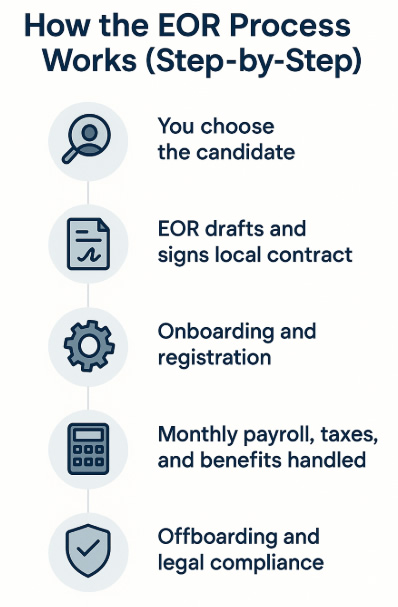
How the EOR Process Works (Step-by-Step)
Using an Employer of Record (EOR) might sound complex at first, but the process is surprisingly fast, streamlined, and risk-free — especially when compared to setting up a local entity. Here’s how it typically works from start to finish:
1. You Identify the Talent
Your company handles sourcing and recruitment as usual. Whether through LinkedIn, your ATS, or a local recruiter, you find the ideal candidate in Indonesia for your role.
✅ You stay in control of the hiring decision.
2. The EOR Drafts a Compliant Employment Contract
Once you’ve selected a candidate, the EOR provider (e.g., Multiplier, Deel, or Papaya Global) prepares a legally compliant local employment contract, in Bahasa Indonesia and English.
This includes:
- Salary and payment structure
- Working hours
- Benefits and statutory leave
- Probation period
- Termination clauses
✅ The contract is tailored to Indonesian labor law and any sector-specific regulations.
3. Onboarding and Registration
The EOR handles all administrative onboarding, including:
- Registering the employee with BPJS Kesehatan (health insurance) and BPJS Ketenagakerjaan (social security)
- Setting up tax IDs and reporting frameworks
- Ensuring banking info is ready for salary deposits
The EOR acts as the legal employer, while you remain the operational manager.
✅ Employee gets access to benefits and government protection immediately.
4. Ongoing Payroll, Taxes, and Benefits
Each month, the EOR:
- Calculates gross-to-net salary (including tax withholding and deductions)
- Remits employee and employer contributions to authorities
- Issues local payslips and payroll summaries
- Manages statutory benefits and leave tracking
- Ensures ongoing compliance with evolving regulations
You simply receive a single consolidated invoice covering:
- Employee salary
- Payroll taxes & benefits
- EOR service fee (typically $300–700/month)
✅ No need to handle local accountants, tax advisors, or benefit platforms.
5. Invoicing and Reimbursement
At the start of each pay cycle (monthly), the EOR sends you a clear invoice with:
- Itemized salary and employer costs
- EOR fees
- Payment deadline
You pay the invoice, and the EOR distributes salaries and submits taxes on your behalf.
✅ Everything is centralized — you don’t deal with local banks or government portals.
6. Termination, Offboarding, and Support
If the employee leaves (voluntarily or not), the EOR:
- Handles formal resignation or termination letters
- Calculates severance and final pays
- Deregisters the employee from BPJS and tax systems
- Advises you on dispute resolution, if needed
They also provide legal guidance to ensure that termination complies with local law, avoiding future liabilities.
✅ Full offboarding compliance, without legal risk.
7. Continuous Local Support
Throughout the employment lifecycle, the EOR offers:
- HR support for local holidays, sick leave, and maternity regulations
- Local expertise on bonuses like THR (Tunjangan Hari Raya)
- Guidance on contract changes, performance issues, or promotions
You get the benefit of a local HR team without having to build one.
Bottom Line:
With an EOR, you focus on growing your business — while they handle the complex HR, tax, and legal challenges of hiring in Indonesia.
Whether you’re hiring a single software developer or building a full regional sales team, the EOR process allows you to start in days — not months.
Top EOR Providers for Hiring in Indonesia
| EOR Provider | Best For | Entity Setup Required | Supports Contractors | Payroll in Indonesia | Integrated Benefits | Local Compliance Support |
|---|---|---|---|---|---|---|
| Multiplier | Startups scaling in Asia | No | Yes | Yes | Yes | Strong |
| Deel | Global teams & contractors | No | Yes | Yes | Yes | Strong |
| Papaya Global | Large companies & HR teams | No | Yes | Yes | Yes | Very Strong |
| Gusto | US-based companies only | No | Limited (US only) | No | Yes (US only) | N/A |
When Should You Use an EOR vs Set Up a Local Entity?
| Situation | Best Solution |
|---|---|
| Hiring 1–5 employees for remote work | EOR (fast & cost-effective) |
| Testing market entry without legal risk | EOR |
| Planning long-term operations in Indonesia | Local entity may make sense after 12+ months |
| Needing to hire only contractors | Use Deel or Multiplier |
| Already have a legal presence | Use Papaya or Gusto for HR/payroll management |
Is Using an EOR Legal in Indonesia?
Yes. The EOR model is fully legal when done via a registered, compliant provider. All labor contracts are between the employee and the EOR (not your company), ensuring full compliance with BPJS (social security), taxes, and employment laws.
Make sure you:
- Choose an EOR with a local partner or entity in Indonesia
- Ensure they provide monthly payroll reports and support termination/legal issues
- Confirm they register employees with BPJS Kesehatan and Ketenagakerjaan
📌 Key Takeaways
- Hiring directly in Indonesia without an entity is not legally viable
- EORs like Multiplier, Deel, and Papaya Global allow safe, fast hiring
- EORs handle payroll, tax, contracts, benefits, and legal compliance
- You maintain full control of employee performance and work
✅ Get Started with Multiplier
Ready to expand your team in Indonesia without the hassle of legal setup?
👉 Book a Free Demo with Multiplier
Start hiring in just 7 days — with full compliance.
🙋 FAQ: Hiring in Indonesia Without an Entity
Can I hire a full-time employee in Indonesia without an entity?
Yes, using an EOR like Multiplier or Deel allows you to legally hire full-time employees without setting up a subsidiary.
How long does it take to onboard an employee via EOR?
Usually between 5–10 business days depending on documentation and contract approval.
How much does an EOR service cost?
Fees range from $299 to $699/month per employee, depending on the provider and services.
Can I offer stock options or bonuses?
Yes — EORs can handle variable compensation like bonuses and equity grants with proper documentation.
Is Gusto a good choice for hiring in Indonesia?
Not directly — Gusto is more suitable for US-only teams. Use Deel or Multiplier for Indonesia.
Get Your HR Brand Featured on HRYP
Reach HR and business technology audiences with sponsored editorial coverage, vendor visibility and managed launch campaigns built for HR tech, SaaS and AI brands.
Sponsored editorial features from $170, with managed visibility and launch packages available.
