

Deel Review 2026
Disclosure: This post contains affiliate links. We may earn a commission at no extra cost to you.
If your company is hiring internationally, there is a good chance Deel has already come up in your research. It is one of the most visible names in global hiring, international payroll, and contractor management. The real question, however, is not whether Deel is popular. The real question is whether it is actually the right platform for your business.
If you prefer a quick overview first, watch this short Deel review before reading the full article.
That is what this review is about.
Instead of repeating a generic feature list, this is a practical breakdown of where Deel stands out, where it may be too much for some teams, and which types of companies are most likely to get real value from it. If you are evaluating tools for global expansion, remote hiring, or multi-country payroll operations, this is the stage where surface-level content stops being useful. You need to know whether Deel can simplify real operational work, reduce risk, and save time for HR, finance, and leadership.
In our view, Deel is strongest when a company needs to do one or more of these things well:
- hire employees in countries where it does not have entities,
- manage and pay international contractors without creating admin chaos,
- centralize payroll and compliance across multiple countries,
- replace fragmented international HR workflows with a more unified system.
For the right company, that can be a major advantage. For the wrong company, it can be more platform than you really need.
Quick verdict
Deel is one of the strongest options on the market for businesses that want to hire, pay, and manage international workers without stitching together separate tools for contracts, payroll, compliance, and contractor administration.
Its biggest strength is not one single feature. It is the fact that several important global workforce functions can live in one place. That matters a lot once a company starts operating across multiple countries and worker types.
Where Deel looks especially strong:
- Employer of Record for international employees,
- global payroll for distributed teams,
- contractor onboarding, management, and payments,
- operational simplicity for growing companies hiring across borders.
Where it may not be ideal:
- very small local-only companies,
- teams that only need a basic domestic payroll tool,
- buyers looking for the cheapest possible solution rather than an international operations platform.
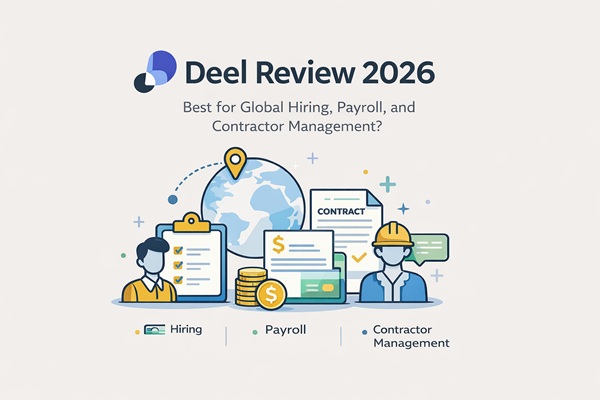
What Deel is best for
Deel makes the most sense for companies that have already moved beyond simple local hiring. If your team is hiring in one country only, using one employment model, and facing no real international compliance complexity, Deel may feel bigger than necessary.
But if your business is hiring remote talent across several countries, using both employees and contractors, or planning to expand internationally without opening local entities right away, Deel starts to look far more compelling.
That is the key lens for reviewing it.
Deel is not just a payment tool. It is not just an HR system. And it is not just an Employer of Record provider either. Its value comes from combining these workflows in a way that can reduce friction between HR, legal, finance, and operations.
That is why Deel tends to be most relevant for:
- startups growing internationally faster than their internal ops team can scale,
- mid-sized companies expanding into new countries,
- distributed businesses managing employees and contractors together,
- finance and people teams trying to reduce admin across global workforce operations.
1) Deel for Employer of Record: one of its strongest use cases
If you are evaluating Deel seriously, Employer of Record is probably one of the first things you are looking at.
This is also one of the clearest reasons to use the platform.
An Employer of Record model is useful when you want to hire an employee in another country without opening your own legal entity there. Instead of spending months dealing with setup, local employment infrastructure, and ongoing compliance administration, you use a provider that can employ the worker on your behalf while the person still works for your business.
That is where Deel is especially appealing. It is built around helping companies hire internationally without turning every new country into a separate legal project.
From a buyer’s perspective, the appeal is simple:
- faster entry into new markets,
- less legal and payroll complexity,
- a more structured onboarding process,
- employment administration folded into the same broader platform.
In practical terms, this matters most when your company has found the right person but does not want the delay, cost, and legal overhead of creating a local entity first.
Our take is that Deel becomes very attractive here because EOR is not isolated from the rest of the workflow. It sits alongside payroll, contracts, payments, and broader workforce operations. That creates a cleaner operating model than using one vendor for EOR, another for payroll, and another for contractor administration.
Where buyers should still think carefully is scale and fit. If your company only plans to make one or two international hires and has no broader global hiring strategy, you may want to compare whether a full global workforce platform is justified. But for teams building repeatable international hiring processes, Deel’s EOR capability is one of its strongest arguments.
2) Deel for Global Payroll: strong when payroll complexity is growing
Global payroll is where many companies start to feel real operational pain.
At first, international hiring may look manageable. Then the hidden complexity shows up: different countries, different local rules, different pay cycles, different tax expectations, different currencies, and different internal stakeholders trying to make sense of it all.
This is where Deel looks most valuable to finance and operations leaders.
The platform’s payroll appeal is not just about paying people. It is about organizing and standardizing multi-country payroll processes in a way that feels more manageable as the business grows.
If your current setup involves spreadsheets, manual approvals, disconnected vendors, and too much back-and-forth between HR and finance, Deel is positioned to solve a real business problem, not just a cosmetic one.
What stands out in the payroll use case is the centralization. Businesses scaling internationally usually do not struggle because payroll exists. They struggle because payroll becomes fragmented. Deel’s value proposition is that it gives companies a more unified system for running payroll across countries while keeping compliance and workforce administration closer together.
That is especially relevant for:
- companies hiring in multiple jurisdictions,
- teams moving from ad hoc international payments to structured payroll operations,
- businesses that want more visibility and consistency across countries.
In our view, Deel is less compelling here for purely domestic companies. If your challenge is only local payroll in one market, there are more focused tools that may be simpler and cheaper. But once payroll becomes international and operationally messy, Deel starts to justify its place much more clearly.
3) Deel for Contractor Management: probably the easiest entry point for many teams
Not every company needs EOR immediately. Many start with contractors first.
That makes contractor management one of Deel’s most practical and accessible use cases.
For a lot of businesses, the first global hiring challenge is not “How do we employ full-time workers in new countries?” It is “How do we onboard, pay, and manage international contractors without making every month harder than it should be?”
Deel is well positioned for that problem.
Contractor workflows tend to break down when companies grow quickly. The issues are familiar:
- inconsistent agreements,
- manual payment coordination,
- country-specific confusion,
- finance tickets around payout timing,
- no clean path from contractor to employee later on.
Deel’s contractor management angle is strong because it gives companies a structured way to bring contractors into one system and manage them with more consistency. That is useful on its own. It becomes even more useful when the business later decides to convert some contractors into employees or mix contractor hiring with EOR hiring in the same broader operating model.
That flexibility is one of the reasons Deel feels more strategic than a simple contractor payment tool. It can support companies at the contractor stage and still remain relevant when the workforce model gets more sophisticated.
If your business hires globally but is not yet ready to build out a full entity structure, contractor management may be the easiest reason to start with Deel.
See how Deel can support global contractors, payroll, and hiring
What stands out most about Deel
After reviewing Deel as a buyer-facing solution, three things stand out more than anything else.
A broader operational scope than many buyers initially expect
Many people discover Deel because of one urgent problem: international hiring, contractor payments, or global payroll. Then they realize the platform sits in a wider operational category. That matters because growing companies rarely deal with these issues in isolation. Once global hiring starts, payroll, compliance, onboarding, documentation, and internal processes all get pulled into the same conversation.
Deel looks strong because it is built around that reality.
It is easier to justify when complexity is real
Some software looks attractive in theory but feels hard to justify in practice. Deel is almost the opposite. If your business truly faces cross-border workforce complexity, the value proposition becomes easier to understand. The more fragmented your current operations are, the easier it is to see why a consolidated platform can help.
It feels built for companies that are scaling, not just experimenting
Some businesses are just testing international hiring. Others are building a real long-term global team. Deel looks much more aligned with the second group. It feels like a platform designed for repeatable international operations, not just occasional edge cases.
Possible drawbacks and trade-offs
No honest review is useful if it reads like a sales page, so it is worth being clear about where Deel may not be the perfect fit.
It may be more platform than some teams need
If your company hires locally only, runs one-country payroll, and has no real international expansion plan, Deel may be unnecessary. In that situation, a more focused local payroll or HR solution may be easier to implement and justify internally.
The strongest value appears when your global hiring needs are real
Deel is easiest to defend as an investment when international hiring, payroll, or contractor complexity is already costing your team time and creating operational risk. If that pain is still theoretical, the urgency may not be there yet.
Buyers should still evaluate workflow fit carefully
Even a strong platform should be judged against your actual operating model. How many countries are you hiring in? Do you rely heavily on contractors? Are you planning to hire employees without local entities? Do HR and finance need shared visibility? The better you answer those questions, the easier it becomes to decide whether Deel is a fit or whether you are solving a smaller problem than you think.
Who Deel is a good fit for
Deel is a strong fit for:
- companies hiring internationally across multiple countries,
- businesses that need EOR, contractor management, and payroll in one broader system,
- remote-first or distributed teams building long-term global operations,
- HR and finance teams that want fewer fragmented workflows,
- growing companies that need structure, compliance confidence, and scalability.
Who may want to look elsewhere first
Deel may be less urgent for:
- businesses with purely domestic hiring needs,
- very small teams with no meaningful international expansion plan,
- buyers who only need a narrow payroll function in one market,
- companies choosing purely on lowest cost rather than operational breadth.
Final verdict: is Deel worth it in 2026?
Yes, for the right type of company, Deel is absolutely worth serious consideration in 2026.
It is not because it claims to do everything. It is because the platform addresses a real problem many growing companies face: global workforce operations become messy fast. Hiring across borders sounds exciting in strategy decks, but in daily operations it creates friction across payroll, compliance, contracts, payments, and admin.
Deel’s strongest case is that it brings several of those moving parts together in a way that can make international hiring more scalable and less chaotic.
If your business is comparing solutions because you want to hire employees abroad without entities, manage international contractors with less friction, or bring more order to global payroll, Deel is one of the most credible platforms to have on your shortlist.
If your needs are smaller, more local, or more basic, it may be too much platform for the job. But for companies with real international hiring ambition, Deel looks like one of the most complete options available right now.
Want to evaluate Deel for your team?
Explore Deel here
Related reading on HRYP
- Deel listing on HRYP
- How to Use Deel
- Why Companies Choose Deel to Manage Global Teams
- Deel Payments & Wallet Explained
Get Your HR Brand Featured on HRYP
Reach HR and business technology audiences with sponsored editorial coverage, vendor visibility and managed launch campaigns built for HR tech, SaaS and AI brands.
Sponsored editorial features from $170, with managed visibility and launch packages available.
