

Introduction: How AI Is Reshaping Inclusive Hiring in 2025
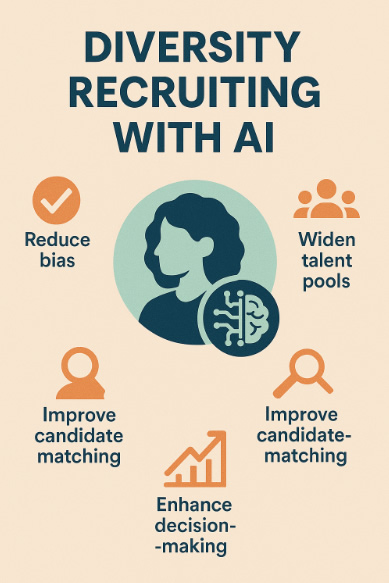
Diversity hiring is evolving rapidly, and artificial intelligence is at the heart of this transformation. In 2025, companies of all sizes are leveraging AI-powered platforms to build more inclusive and representative teams. These tools aren’t just buzzworthy add-ons; they are practical solutions that remove unconscious bias, improve decision-making, and streamline the recruitment lifecycle.
AI-driven diversity recruiting tools support everything from writing job descriptions to sourcing candidates, conducting interviews, and measuring DEI performance. The result is not just a more equitable hiring process, but one that is faster, more efficient, and better aligned with the values of a modern workforce.
Below, we dive into the best AI tools designed specifically to promote diversity in hiring—exploring their core functions, benefits, and ideal use cases.
1. Textio – Writing Inclusive Job Descriptions with AI
AI Function: Natural Language Processing (NLP) for bias detection in job descriptions
Use Case: Real-time editing and guidance for inclusive, bias-free language in hiring content
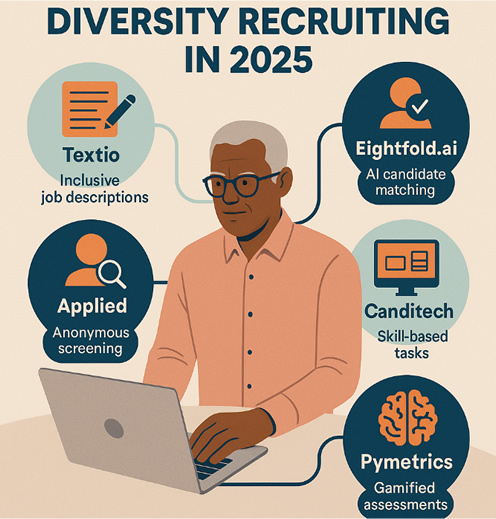
Textio has become a go-to platform for companies looking to make their job postings more inclusive. The tool scans job descriptions using NLP to detect phrases that may be subtly biased toward a specific gender, age group, or cultural background. It provides real-time suggestions for improvements and shows the expected impact of changes through predictive analytics.
Textio doesn’t just help edit text—it learns from your organization’s past performance and from industry benchmarks. For example, if your previous job ads underperformed in attracting female candidates, Textio will flag the problematic language patterns and offer data-driven alternatives.
It’s ideal for small to mid-sized companies that don’t have in-house DEI specialists but want to level the playing field right at the top of the funnel.
Case Insight: A mid-sized fintech firm saw a 40% increase in female applicants after rewriting their job descriptions using Textio.
2. Eightfold.ai – AI Matching for Underrepresented Talent
AI Function: Deep-learning talent intelligence and skill-based matching
Use Case: Scanning resumes and matching candidates based on potential and transferable skills
Eightfold.ai is a powerful talent intelligence platform designed to reduce hiring bias and surface underrepresented talent. Its AI doesn’t rely solely on past job titles or education; instead, it identifies adjacent and transferable skills, helping recruiters discover high-potential candidates from non-traditional backgrounds.
One of its standout features is the DEI dashboard, which offers insights into your talent pool’s diversity profile. Recruiters can set diversity goals and filter their sourcing strategies accordingly, all while remaining compliant with fairness regulations.
This tool is especially useful for enterprises or scaling companies that need to evaluate thousands of applications quickly without falling into pattern-based (and often biased) decisions.
Pro Tip: Use Eightfold’s AI to set blind hiring filters that focus purely on skill alignment.
3. Applied – AI-Powered Anonymous Screening
AI Function: Behavioral science combined with anonymized, merit-based scoring
Use Case: Anonymous application review and structured assessments for fair hiring
Applied is a recruitment platform designed specifically to minimize unconscious bias. It removes personal identifiers such as names, schools, and even employment gaps, focusing instead on structured responses to job-relevant scenarios.
Its AI scoring system evaluates responses based on pre-set rubrics, providing each applicant with a fair and consistent experience. Recruiters can view ranked candidates without ever seeing their identities, drastically reducing the influence of gender, ethnicity, or social background.
For startups or small teams without HR departments, Applied offers a complete toolkit to implement bias-free hiring without needing DEI expertise.
Small Business Win: A London-based agency used Applied and improved the gender balance of its hires from 37% to 59% in under a year.
4. Pymetrics – Neuroscience-Based Diversity Assessments
AI Function: Gamified assessments using behavioral and cognitive neuroscience
Use Case: Matching candidates to roles based on emotional, social, and cognitive traits
Pymetrics is one of the most innovative platforms in AI-based recruiting. It offers a set of interactive, neuroscience-based games that assess how candidates make decisions, solve problems, and react under pressure. These games replace traditional resumes and cover letters with data-backed insights into cognitive and behavioral strengths.
What sets Pymetrics apart is its rigorous fairness testing. Every assessment model is audited to ensure it is free from gender and ethnic bias. Employers can also benchmark successful employee traits and use those models to identify similar profiles in new applicants.
It’s especially effective for internship and graduate-level hiring, where resumes offer little insight into true capability.
Use Case Highlight: A multinational used Pymetrics to expand socio-economic diversity in its internship program, increasing representation by 33%.
5. Canditech – AI-Powered Role Simulation Assessments
AI Function: Customized job simulations and structured video interviews
Use Case: Evaluating candidates through real-life tasks, technical challenges, and situational judgment tests
Canditech allows recruiters to assess candidates using tailored simulations that replicate the actual work environment—such as analyzing spreadsheets, coding tasks, or writing sales emails. Its AI grades responses based on both technical correctness and soft skill indicators.
The platform also supports asynchronous video interviews with customizable rubrics and DEI safeguards. It anonymizes certain candidate data and provides detailed reports to reduce subjective decision-making.
Canditech is particularly useful for roles where practical performance outweighs academic or professional pedigree—ensuring that candidates are judged by what they can do, not who they are.
Practical Impact: A tech firm reduced turnover in junior roles by 22% after switching to Canditech’s work sample-based assessments.
Comparison Table: Key AI Tools for DEI Hiring
| Tool | AI Function | Strengths | Best For |
|---|---|---|---|
| Textio | Natural Language Processing (NLP) for bias detection in job descriptions | Real-time inclusive language suggestions; measurable impact on gender bias | Creating unbiased job ads for small and mid-sized teams |
| Applied | Anonymized candidate screening using behavioral science | Removes identifying information to ensure merit-based evaluations | Early-stage hiring with limited recruiter resources |
| Eightfold.ai | Talent intelligence and skill-based matching using deep learning | Highlights transferable skills; DEI filters; high-volume sourcing | High-growth companies with DEI sourcing goals |
| Pymetrics | Neuroscience-based gamified assessments with fairness validation | Fair and engaging assessments; eliminates reliance on resumes | Internship and graduate hiring with fairness focus |
| Canditech | Role simulation and structured video interviewing | Job-relevant testing; DEI-aware scoring; supports hard and soft skill evaluation | Hands-on hiring for technical, sales, and analytical roles |
Conclusion: AI That Champions Human Fairness
Artificial intelligence can’t fix hiring bias alone, but it can significantly mitigate it. By automating repetitive decisions, anonymizing candidate data, and focusing on skills and behaviors, AI-based tools are redefining inclusive recruitment in 2025.
Companies that invest in these platforms aren’t just ticking the DEI box—they’re creating systems that unlock untapped talent and foster truly inclusive workplaces. Whether you’re a 10-person startup or a global enterprise, adopting even one of these tools can make a measurable difference.
Get Your HR Brand Featured on HRYP
Reach HR and business technology audiences with sponsored editorial coverage, vendor visibility and managed launch campaigns built for HR tech, SaaS and AI brands.
Sponsored editorial features from $170, with managed visibility and launch packages available.
