

Introduction: Why HR Platform Companies Are Reshaping the Future of Work
Just a few years ago, most HR teams were juggling a patchwork of spreadsheets, paper forms, and disconnected tools to manage their workforce. Payroll was handled in one system, recruitment in another, and performance reviews were buried in endless email threads. The result? Lost time, inconsistent data, and a frustrating experience for both HR professionals and employees.
HR platform companies have rewritten that story.
Today, they act as the central nervous system of modern organizations — connecting every stage of the employee lifecycle into a single, intelligent, and user-friendly platform. From the moment a candidate applies for a job to the day they offboard, every interaction, document, and process can be managed in one place.
This shift is not just about efficiency; it’s about strategic impact. Modern HR platforms provide:
- Real-time analytics that help leaders make faster, smarter decisions.
- Automation that removes repetitive admin work and frees HR teams to focus on people, not paperwork.
- Compliance tools that adapt to local labor laws, tax regulations, and privacy requirements in multiple countries.
- Employee engagement features that improve morale, retention, and company culture.
The best HR platform companies are also embracing artificial intelligence, predictive analytics, and integrations with finance, IT, and communication tools. This means HR is no longer a back-office function — it’s a driver of growth, a guardian of compliance, and a champion of employee experience.
In this guide, we’ll explore the top HR platform companies to watch in 2025, compare their strengths, and help you choose the one that fits your business — whether you’re a growing startup, a mid-sized firm, or a multinational enterprise.
What Is an HR Platform?
An HR platform is the operating system of your workforce: a unified software layer that centralizes employee data and orchestrates HR processes across the full employee lifecycle—from recruiting and onboarding to payroll, performance, learning, and offboarding. Unlike point solutions that solve a single task, modern platforms bundle multiple HR capabilities into an integrated, data-driven environment with automation, analytics, and employee self-service at the core.
Core Building Blocks (What’s inside)
- Core HR / HRIS (System of Record): Employee master data, org structure, job & position management, documents, contracts, digital signatures, audits.
- Payroll & Benefits: Gross-to-net, tax filing, year-end forms, benefits enrollment, deductions, eligibility rules, open enrollment workflows.
- Time, Attendance & Scheduling: Clock-in/out, PTO accruals, leave management (FMLA, parental), shift planning, overtime rules.
- Talent Acquisition (ATS): Job postings, career pages, resume parsing, structured interviews, offer management, background checks.
- Onboarding & Offboarding: Pre-boarding portals, asset provisioning, compliance packs, probation tracking, exit workflows.
- Performance & Talent: Goals/OKRs, check-ins, 1:1s, reviews, 9-box, calibration, succession planning, career paths.
- Compensation & Rewards: Pay bands, cycles & approvals, bonus/equity, pay equity analysis, recognition programs.
- Learning (LMS/LXP): Course catalogs, pathways, compliance training, skills tagging, microlearning, certifications.
- Engagement & EX (Employee Experience): Surveys/eNPS, pulse checks, communities, recognition, comms hub, intranet widgets.
- Workforce Planning & Analytics: Headcount plans, capacity, skills inventory, predictive attrition, cost modeling.
- HR Service Delivery: Knowledge base, HR helpdesk/ticketing, case management, SLA reporting.
Tip: SMB-focused platforms tend to emphasize payroll + time + onboarding simplicity. Enterprise suites add advanced analytics, succession, global payroll, and governance.
Architecture & Integrations (How it connects)
Modern HR platforms are usually SaaS with:
- APIs (REST/GraphQL) for data exchange with accounting (e.g., GL), ERP, ITAM/MDM, identity providers, and collaboration suites.
- SSO & Identity: SAML/OIDC, SCIM for user provisioning/deprovisioning.
- Eventing: Webhooks for real-time actions (e.g., trigger IT device provisioning on “new hire”).
- Flat-file/SFTP bridges for legacy payroll or government filings when APIs aren’t available.
- Marketplace/Apps: Prebuilt connectors for job boards, background checks, benefits carriers, learning libraries, etc.
Data Model & Governance
- Golden record: One employee profile feeding every workflow.
- RBAC & least privilege: Role-based access, data minimization, audit logs.
- Compliance: GDPR/CCPA (consents, data subject rights), SOC 2/ISO 27001, data residency options, retention policies, e-signature legality.
- Quality: Validation rules, duplicates prevention, effective-dated changes, sandbox/UAT environments.
AI in HR Platforms (Practical use cases)
- Talent: Resume parsing, job-candidate matching, interview question generation, offer recommendations.
- Service: HR chat assistants for policy Q&A, knowledge retrieval.
- People Analytics: Predicting attrition, skills inference, pay equity alerts.
- Content: Draft goals, review summaries, learning recommendations.
Guardrails: bias monitoring, explainability, and human-in-the-loop approvals remain essential.
Employee Experience Layer (Why employees love it)
- Self-service: Profile updates, payslips, PTO requests, benefits changes, reimbursement.
- Mobile-first: Native apps for time, shifts, approvals, and learning on the go.
- Comms & Community: Broadcasts, surveys, recognition feeds, kudos.
Deployment Models
- Cloud/SaaS (dominant): Continuous updates, faster time-to-value, lower IT overhead.
- Hybrid/On-prem (niche): For regulatory, union, or extreme customization scenarios.
Implementation Lifecycle (What to expect)
- Discovery & Fit-Gap: Processes, integrations, compliance needs, countries/entities.
- Configuration vs Customization: Prefer config & extensions over code-heavy forks.
- Data Migration: Cleanse, map, test; decide cutover vs phased rollout.
- Integrations: Identity, payroll, finance, IT, comms; prioritize “hire to retire” flows.
- Change Management: Exec sponsorship, comms plan, champions, enablement.
- Testing & UAT: Scenarios, edge cases (retro pay, complex leave, multi-currency).
- Go-Live & Hypercare: Stabilize, monitor, fix gaps; success metrics.
- Optimize: Automations, analytics, adoption campaigns.
Pricing & Total Cost of Ownership (TCO)
- Models: Per-employee-per-month (PEPM) + base fee; module add-ons (ATS, LMS, analytics); implementation services; premium support.
- Drivers of cost: Countries covered, payroll complexity, integrations, data migration, training.
- EOR/Global payroll: Typically priced per worker/country with premium for compliance.
Risks & Pitfalls (And how to avoid them)
- Shadow IT / duplicate data: Enforce one system of record and tight integrations.
- Over-customization: Increases cost/upgrade risk—favor standard workflows + light extensions.
- Underestimating change mgmt: Adoption stalls without training and clear “what’s in it for me.”
- Data privacy & residency gaps: Validate certifications and regional hosting early.
- Reporting debt: Define KPIs during design (not after go-live).
Who Is It For?
- Startups/SMBs: Need simplicity, quick setup, payroll + onboarding + time.
- Mid-market: Add performance, learning, compensation cycles, deeper analytics.
- Enterprise/global: Multi-entity, multi-currency, localized compliance, complex workflows, deep integrations.
| Module | Key Capabilities | Typical Outcomes |
|---|---|---|
| Core HR / HRIS | Employee master data, org charts, docs, e-sign, audits | Single source of truth, fewer errors, faster audits |
| Payroll & Benefits | Gross-to-net, filings, benefits enrollment, carriers | Reduced penalties, on-time payroll, happier employees |
| ATS & Onboarding | Career pages, parsing, structured interviews, pre-boarding | Lower time-to-hire, better candidate experience |
| Performance & Talent | Goals/OKRs, reviews, 9-box, succession | Higher productivity, clearer career paths, retention |
| Learning (LMS/LXP) | Courses, compliance, skills tagging, certifications | Faster ramp-up, compliance coverage, skills growth |
| Engagement & EX | Surveys, eNPS, recognition, comms hub | Higher eNPS, reduced attrition, stronger culture |
| Analytics & Planning | Dashboards, predictive models, scenario plans | Data-driven decisions, proactive risk management |
KPI & Metrics You Can Track From Day One
- Hiring: Time-to-hire, cost-per-hire, offer acceptance rate, source quality.
- Workforce: Turnover/attrition, absenteeism, internal mobility, diversity ratios.
- Payroll: Accuracy rate, off-cycle % , retro corrections, payroll cycle time.
- Engagement: eNPS, response rates, sentiment trends.
- Learning: Completion %, time to proficiency, certifications on-time.
Build vs Buy (and Hybrid)
- Buy if you want faster value, best practices, updates, security/compliance offloaded.
- Build/extend only for truly differentiating processes; otherwise you’ll carry upgrade debt.
- Hybrid: standard platform + light custom apps via APIs/low-code.
Real-World Examples of HR Platforms in Action
1. Small Business – Payroll & Onboarding Made Simple (Gusto)
Imagine you’re running a 15-person marketing agency in New York. Every month, payroll eats up hours of your time, and onboarding new hires means chasing paper forms. With a platform like Gusto, you can:
- Run payroll in minutes, with taxes automatically filed.
- Offer health benefits and 401(k) plans without needing a broker.
- Send digital offer letters and have new hires complete onboarding online.
✅ Result: Zero payroll errors, faster hiring, and a better first-day experience.
2. Mid-Market – Scaling HR Across States (Paylocity)
A growing manufacturing firm with 300 employees across five U.S. states struggles with compliance, PTO policies, and tracking performance reviews. By switching to Paylocity, they:
- Consolidate time tracking, PTO requests, and payroll into one system.
- Ensure each state’s labor laws and tax requirements are met.
- Automate performance review cycles with reminders and templates.
✅ Result: HR spends less time on admin and more on employee engagement.
3. Enterprise – Global Hiring & Compliance (Deel)
A SaaS company headquartered in London wants to hire developers in Brazil, designers in the Philippines, and sales reps in the U.S. Without a local entity in each country, compliance is a nightmare. Deel solves it by:
- Acting as Employer of Record (EOR) in over 150 countries.
- Managing local payroll, benefits, and tax filings.
- Providing a single dashboard to track all international team members.
✅ Result: The company expands globally in weeks, not months, without legal headaches.
💡 Pro Tip:
You can explore a full directory of vetted HR platform companies — including Gusto, Paylocity, Deel, and more — right here on HRYP.com. Compare features, pricing, and reviews before making your choice.
How to Choose the Right HR Platform
Selecting the right HR platform isn’t just a software purchase — it’s a long-term investment that will shape how your organization hires, pays, develops, and retains its people for years to come. The wrong choice can mean wasted budget, low adoption, and compliance risks; the right choice can become the backbone of a high-performing, engaged workforce.
Here’s a step-by-step framework to make the decision with confidence:
1. Define Your Goals and Pain Points
Before looking at vendors, clarify:
- Are you replacing spreadsheets/manual processes?
- Do you need to unify multiple existing HR tools into one platform?
- Is compliance (e.g., GDPR, multi-country payroll) a major driver?
- Are you aiming to improve employee engagement or recruitment speed?
📌 Pro Tip: Write down your top 5 “must-solve” problems. Every demo and proposal should show exactly how the platform addresses these.
2. Identify Your Core Requirements
HR platforms can be modular or all-in-one. Decide what’s essential now and what can be added later:
- Core HR / HRIS
- Payroll & benefits
- Time & attendance
- Recruitment / ATS
- Onboarding
- Performance management
- Learning & development
- Analytics & reporting
⚠️ Avoid overbuying: paying for advanced modules you won’t use for 2–3 years can inflate costs unnecessarily.
3. Match the Platform to Your Company Size & Growth Plans
- Startups / SMBs: Look for easy setup, quick ROI, simple payroll, and low training requirements.
- Mid-Market: Focus on scalability, automation, and integrations with existing tools.
- Enterprise / Global: Prioritize multi-entity management, local compliance, and advanced analytics.
💡 If you plan to double headcount in the next 18 months, choose a platform that can grow without a painful migration.
4. Check Integration Capabilities
The best HR platforms connect seamlessly with:
- Payroll processors
- Accounting/ERP
- CRM systems
- Collaboration tools (Slack, Teams)
- Identity management (SSO, SCIM)
- Learning platforms
📌 Ask vendors for API documentation or a list of pre-built integrations. Avoid systems that create “data silos.”
5. Prioritize User Experience (UX)
Your HR team will use it daily, but so will employees and managers.
Look for:
- Clean, intuitive interface
- Mobile app availability
- Self-service capabilities
- Multilingual support if you have global teams
📊 A clunky UX leads to low adoption rates and wasted investment.
6. Evaluate Compliance & Security
HR platforms handle sensitive personal data. Non-compliance can be costly.
- Check for certifications: SOC 2, ISO 27001, GDPR compliance.
- Ask where data is stored (data residency).
- Look for built-in compliance alerts and audit trails.
7. Compare Pricing Models
Typical pricing is per employee, per month (PEPM) plus:
- Setup/implementation fees
- Optional modules
- Support tiers
💡 Beware of “introductory pricing” that rises sharply after year one.
8. Involve Stakeholders Early
Include:
- HR managers (process owners)
- Payroll/accounting (financial accuracy)
- IT/security (integrations & data protection)
- Department heads (adoption needs)
A collaborative selection process reduces resistance at rollout.
9. Test Before You Commit
- Request a sandbox demo with real workflows.
- Have multiple team members test common tasks (adding a new hire, running payroll, pulling reports).
- Measure task completion time vs current process.
10. Plan for Change Management
A great tool can still fail without a proper rollout plan:
- Training sessions for HR, managers, and employees.
- Clear communication on why the change is happening.
- Internal champions who promote adoption.
Checklist: Vendor Questions to Ask
- How often is the software updated?
- What’s the average implementation timeline?
- How many customers in my industry/region use your platform?
- Can I migrate historical data?
- How is customer support structured (hours, channels)?
- Do you offer SLAs (Service Level Agreements)?
Common Mistakes to Avoid
- Choosing based solely on price
- Ignoring future growth needs
- Overlooking integration requirements
- Not involving end-users in the decision
- Skipping security/compliance verification
💡 Next Step:
Once you’ve shortlisted vendors, check out our HRYP.com HR Platform Directory where you can compare solutions like Gusto, Deel, Paylocity, and much more, complete with features, pricing, and reviews.
Some of the Best HR Platform Companies in 2025
Rippling
- Best For: All-in-one HR + IT + Finance integration.
- Key Features: Payroll, benefits, device management, app provisioning.
- USP: Manages both people and technology in a single platform.
- Website: Visit Rippling
Gusto
- Best For: Small businesses needing affordable payroll and benefits.
- Key Features: Payroll, tax filing, benefits administration, onboarding.
- USP: User-friendly interface with strong compliance tools.
- Website: Visit Gusto
BambooHR
- Best For: Employee experience and performance management.
- Key Features: ATS, onboarding, performance reviews, employee self-service.
- USP: Strong focus on culture and engagement.
- Website: Visit BambooHR
Workday
- Best For: Large enterprises with complex global HR needs.
- Key Features: HCM, payroll, recruiting, talent analytics.
- USP: AI-powered insights and enterprise scalability.
- Website: Visit Workday
Deel
- Best For: Global hiring and contractor management.
- Key Features: EOR services, contractor payments, global payroll.
- USP: Hire and pay talent in 150+ countries.
- Website: Visit Deel
SAP SuccessFactors
- Best For: Multinational corporations.
- Key Features: HCM suite, performance & goals, workforce analytics.
- USP: Enterprise-grade functionality with global compliance.
Personio
- Best For: European SMEs.
- Key Features: Core HR, recruitment, payroll.
- USP: GDPR-compliant, localized for European markets.
| Company | Best For | Core Features | Global Payroll | Compliance | Website |
|---|---|---|---|---|---|
| Rippling | HR + IT integration | Payroll, benefits, device mgmt | Yes | US & Global | Visit |
| Gusto | Small businesses | Payroll, benefits, onboarding | No | US | Visit |
| BambooHR | Employee experience | ATS, onboarding, reviews | Optional | Multi-region | Visit |
Emerging Trends in HR Platforms
The HR technology landscape is evolving at a rapid pace, driven by shifting workforce expectations, global business models, and advances in technology. HR platforms are no longer passive data repositories — they are becoming proactive, intelligent ecosystems that shape strategic decisions.
Here are the key trends redefining the industry in 2025 and beyond:
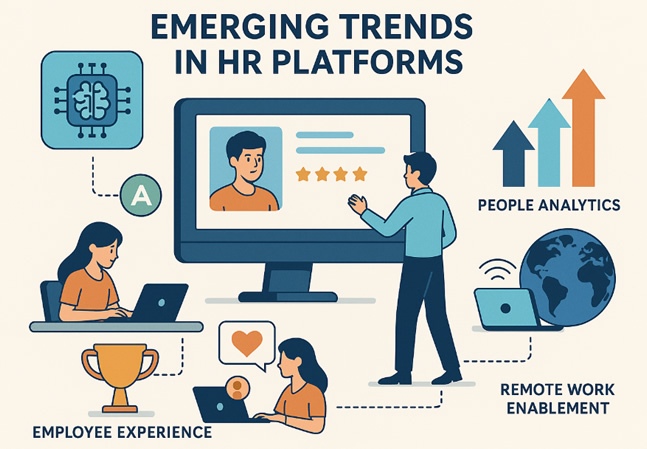
1. AI-Driven Recruitment & Talent Matching
Artificial Intelligence is revolutionizing how companies identify and engage talent:
- Smart Screening: AI algorithms scan and rank CVs based on skills, experience, and cultural fit, reducing manual review time.
- Bias Reduction: Properly trained AI models help remove unconscious bias in job descriptions and candidate selection.
- Predictive Fit: Matching not only skills but also potential performance and likelihood of staying long-term.
- Conversational AI: Chatbots that guide candidates through applications, schedule interviews, and answer FAQs 24/7.
💡 Impact: Faster time-to-hire, reduced cost-per-hire, and better candidate experience.
2. Employee Experience Platforms (EXP)
Today’s workforce expects the same digital convenience from their employer that they enjoy as consumers. EXPs are:
- Personalizing Workflows: Tailored dashboards, content, and learning paths based on role, location, and career stage.
- Encouraging Engagement: Recognition programs, peer feedback, and community spaces.
- Enhancing Well-Being: Integrations with wellness apps, mental health support, and flexible scheduling.
- Simplifying Access: One single point of entry for payroll, benefits, training, and communications.
💡 Impact: Higher engagement scores, improved retention rates, and stronger employer branding.
3. People Analytics & Predictive Insights
Data-driven HR is no longer optional — it’s the competitive edge:
- Turnover Prediction: Identifying at-risk employees before they leave.
- Performance Forecasting: Linking individual performance metrics to business KPIs.
- Diversity & Inclusion Tracking: Monitoring representation and pay equity across the workforce.
- Real-Time Dashboards: Giving managers instant visibility into team productivity, absenteeism, and engagement.
💡 Impact: Moves HR from reactive to proactive, influencing business strategy with concrete data.
4. Remote & Hybrid Work Enablement
Global hiring is the new normal, but it brings complexity:
- Compliance at Scale: Platforms manage multi-country labor laws, tax obligations, and benefits.
- Virtual Onboarding: Seamless pre-boarding, equipment provisioning, and cultural induction for remote hires.
- Collaboration Tools Integration: Embedding HR functions directly into platforms like Slack, Microsoft Teams, or Zoom.
- Digital Presence & Performance Tracking: Ensuring fairness and productivity without micromanagement.
💡 Impact: Wider talent pool, faster international expansion, and higher productivity in distributed teams.
5. Integration of HR with IT & Finance (Bonus Trend)
Forward-thinking HR platforms are breaking down silos by integrating with:
- IT Systems: Automatic device provisioning, app access, and account deactivation when employees join or leave.
- Finance Tools: Linking payroll with expense management, budget forecasting, and financial reporting.
- Unified Dashboards: One view for HR, IT, and finance leaders to track headcount, costs, and compliance.
💡 Impact: Fewer manual processes, reduced errors, and better cross-departmental collaboration.
FAQ – HR Platform Companies
Q1: What is the difference between HRIS and HCM?
An HRIS (Human Resource Information System) is primarily focused on storing and managing employee data, payroll, and compliance records.
HCM (Human Capital Management) expands on this by including talent management, performance tracking, learning, workforce planning, and analytics. Every HCM includes HRIS capabilities, but not all HRIS systems offer full HCM functionality.
Q2: Are all HR platforms cloud-based?
Most modern HR platforms are cloud-based, enabling secure access from anywhere, faster updates, and better scalability. However, some organizations—especially in regulated industries or government—still use on-premises or hybrid systems for compliance or customization reasons.
Q3: Which HR platform is best for global teams?
For international hiring, platforms like Deel and Rippling are strong options:
- Deel offers Employer of Record (EOR) services in 150+ countries.
- Rippling combines HR, IT, and finance management into one platform with global payroll support.
Q4: How much do HR platforms cost?
Pricing varies:
- Small business tools: $5–$15 per employee/month.
- Mid-market suites: $20–$40 per employee/month.
- Enterprise platforms: $50+ per employee/month.
Additional costs may include setup fees, training, and premium support packages.
Q5: Is Workday an HR platform?
Yes. Workday is a cloud-based HR and finance platform offering payroll, scheduling, onboarding, time tracking, learning, talent management, and performance tools. It’s widely used by medium and large organizations.
Q6: Which is better, SAP or Workday?
It depends on your needs:
- SAP SuccessFactors works well for companies deeply integrated with SAP ERP.
- Workday is valued for user experience, frequent updates, and strong analytics.
Q7: Is Workday an ERP or CRM?
Workday is primarily an ERP for HR and finance. It manages internal processes for people and money—not customer relationship management like a CRM.
Q8: What are the top 3 HRIS systems?
Frequently cited leaders include:
- Workday
- SAP SuccessFactors
- Oracle HCM Cloud
Other notable mentions: UKG Pro, ADP Workforce Now, BambooHR.
Extra FAQs – HR Tools for Startups
Q9: What are HR tools for startups?
HR tools for startups are software solutions designed to help early-stage companies manage payroll, recruitment, onboarding, time tracking, and compliance without the need for a large HR team. Many are budget-friendly, intuitive, and scalable. Learn more in our guide Best HR Tools for Startups.
Q10: Which HR tools are best for small businesses and startups?
Some of the most popular tools for startups include:
- Gusto for payroll and benefits
- Deel for global hiring
- BambooHR for employee experience and performance
See the full list in our HR tools comparison for startups.
Q11: How do I choose HR tools for a growing startup?
When selecting HR tools, focus on:
- Scalability as your team grows
- Ease of use for non-technical staff
- Integration with accounting, communication, and project management tools
- Affordability without sacrificing key features
For a complete selection guide, check out our article How to Choose the Best HR Tools for Startups.
Get Your HR Brand Featured on HRYP
Reach HR and business technology audiences with sponsored editorial coverage, vendor visibility and managed launch campaigns built for HR tech, SaaS and AI brands.
Sponsored editorial features from $170, with managed visibility and launch packages available.

[…] contrast, an integrated HR & payroll platform eliminates silos and creates a streamlined hub for all employee data and […]