

Introduction
Employee wellness has shifted from being a perk to a strategic business investment. In 2025, US companies are facing new challenges: remote work fatigue, rising healthcare costs, and increasing employee expectations for holistic wellbeing.
Authoritative data from SHRM’s latest Employee Benefits Survey confirms the priority employers place on health and flexible benefits in the U.S. –> SHRM 2025
This article explores the key employee wellness trends in 2025 that HR leaders and business owners in the US should know. For a complete list of wellness platforms, check out our Top 10 Employee Wellness Solutions for 2025
Top Employee Wellness Trends in 2025
AI-Powered Personalization
- Wellness platforms now use artificial intelligence to deliver personalized programs based on employee health data, stress levels, and preferences.
- Example: Spring Health leverages AI to match employees with the right therapist.
- Why it matters: Employees receive targeted support, increasing engagement and outcomes.
Mental Health at the Core
- Mental health has become a central pillar of corporate wellness.
- Platforms like Modern Health and Calm Business offer therapy, meditation, and on-demand coaching.
- US employers are also introducing mental health days as part of PTO packages. Guidance from the U.S. Surgeon General highlights five essentials for psychologically healthy workplaces Framework.
- Gallup’s workplace research links wellbeing with retention and engagement (Gallup insights).
Mental Health Activities as Part of Workplace Wellness
Wellness in 2025 goes beyond offering access to mental health apps — it also means encouraging practical activities that employees can integrate into their daily routines. From mindfulness breaks to team-based wellbeing initiatives, these activities help normalize mental health conversations at work.
👉 For actionable ideas, explore our dedicated guide: Top 10 Mental Health Activities to Improve Employee Wellbeing at Work
Telehealth and Virtual Care
- Telehealth is here to stay. Employees can now access therapists, doctors, and nutritionists online.
- Companies integrate telehealth services into wellness and benefits programs to reduce healthcare costs.
- Particularly valuable for remote and hybrid teams.
- Recent analyses from HHS/ASPE show the sustained use of tele-behavioral health among Medicaid/Medicare populations (ASPE study – ASPE telehealth hub).
Holistic Wellness Programs
- Wellness now goes beyond fitness to include financial wellness, nutrition, sleep tracking, and family care.
- Platforms like Virgin Pulse and Limeade lead the way with holistic approaches.
- The CDC Workplace Health Promotion resources outline program components and toolkits employers can use to design evidence-based initiatives (CDC Workplace Health).
Gamification of Wellness
- Employers are making wellness fun with gamified challenges such as step competitions, team-based wellness goals, and rewards.
- Wellable is a leader in gamified digital wellness programs.
- Why it works: Gamification boosts engagement and helps sustain long-term healthy habits.
Integration with HR & Payroll Systems
- Modern wellness platforms integrate directly with HRIS and payroll systems.
- Example: linking wellness achievements to PTO or incentive pay.
- Benefit: Simplifies administration while aligning wellness with HR strategy.
ROI-Driven Wellness Investments
- Companies now demand measurable ROI from wellness initiatives.
- Metrics include:
- Reduced absenteeism
- Higher retention
- Improved employee engagement
- CEOs and CFOs increasingly see wellness as part of business strategy, not just HR.
- A classic meta-analysis in Health Affairs found significant savings on medical costs and absenteeism from workplace wellness programs (Baicker et al.).
- The CDC’s toolkits (e.g., Worksite Health ScoreCard) help standardize measurement and continuous improvement (CDC ScoreCard overview).
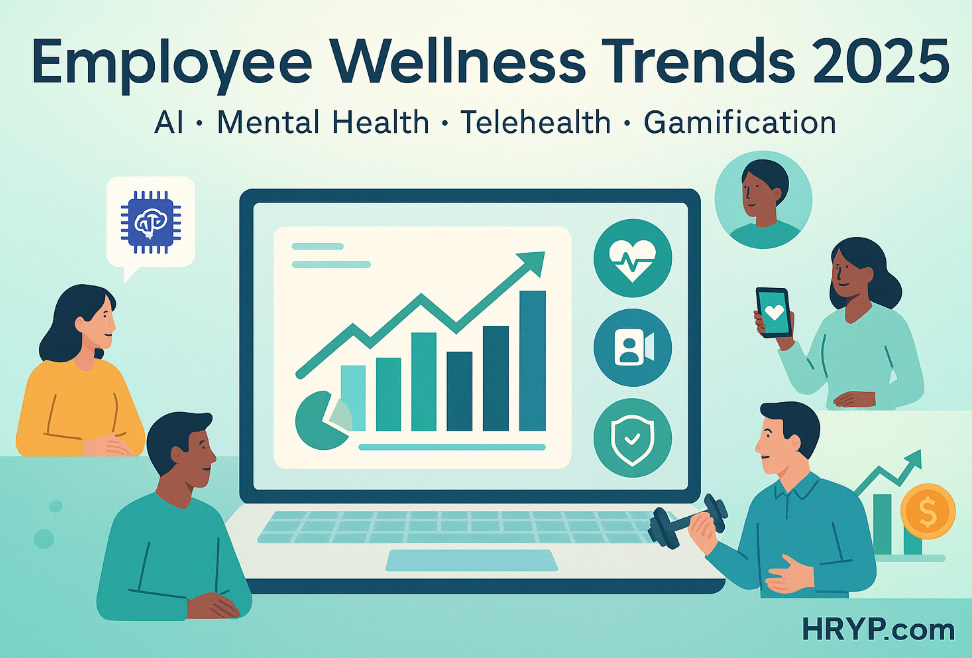
Comparison of Employee Wellness Trends in 2025
| Trend | What it means | Best for | HR Impact / KPI | Example providers | Implementation tips |
|---|---|---|---|---|---|
| AI-Powered Personalization | Wellness plans tailored to each employee via AI (stress, sleep, activity data). | Hybrid/remote teams; fast-growing companies. | Higher adoption, engagement score ↑, program ROI ↑. | Spring Health, Modern Health | Start with opt-in data; set privacy guidelines; pilot with one BU. |
| Mental Health at the Core | Therapy, coaching, meditation and crisis support as a core benefit. | High-stress roles; distributed teams. | Absenteeism ↓, retention ↑, eNPS ↑. | Calm Business, Headspace for Work | Offer multiple modalities (therapy + self-guided); include MH days in PTO. |
| Telehealth & Virtual Care | On-demand access to therapists, nutritionists, physicians. | Multi-state US teams; shift work; remote orgs. | Healthcare costs ↓, time-to-care ↓. | Ginger (Headspace Health), Teladoc-integrated plans | Bundle with medical benefits; communicate 24/7 availability. |
| Holistic Wellness Programs | Beyond fitness: financial, sleep, nutrition, caregiving support. | Enterprises and culture-driven orgs. | Burnout ↓, participation breadth ↑. | Virgin Pulse, Limeade | Map benefits to personas; personalize nudges by cohort. |
| Gamification of Wellness | Challenges, points, leaderboards and rewards. | Sales/ops teams; engagement-focused cultures. | Weekly active users ↑, challenge completion ↑. | Wellable, Gympass | Run 4–6 week sprints; combine team + individual goals; modest rewards. |
| HR/Payroll Integration | Connect wellness incentives to HRIS, PTO, or payroll. | Ops-mature orgs needing automation and reporting. | Admin time ↓, data quality ↑, incentive payout accuracy ↑. | Virgin Pulse, Limeade (HRIS integrations) | Use SSO; define incentive rules; centralize reporting dashboards. |
| ROI-Driven Investments | Funding tied to outcomes (absenteeism, retention, engagement). | CFO-led initiatives; cost-conscious orgs. | Cost per engaged employee ↓, turnover ↓. | Platform-agnostic (set KPI framework) | Baseline KPIs pre-launch; review quarterly; double-down on high-impact cohorts. |
Why These Trends Matter for US Companies
The wellness trends of 2025 are not just HR buzzwords — they are shaping the future of work in the United States. Organizations that embrace these changes gain clear business advantages, while those that ignore them risk falling behind in both talent retention and operational efficiency.
Retaining and Attracting Talent
The US labor market remains competitive, especially for skilled professionals. Wellness initiatives such as mental health programs, telehealth access, and personalized wellbeing make a company more attractive to top candidates. According to Gallup, employees who feel supported in their wellbeing are 69% more likely to stay with their employer long term.
Reducing Costs and Boosting ROI
Rising healthcare expenses in the US put pressure on employers. Preventive wellness solutions — from stress management to fitness and nutrition — help reduce insurance claims and lower absenteeism. Studies show companies can save $2.50–$3.00 for every $1 invested in wellness programs through reduced healthcare costs and improved productivity.
Building a Stronger Employer Brand
Candidates increasingly evaluate companies based on their culture and employee experience. Publicly supporting mental health and holistic wellbeing sends a powerful signal about corporate values. This can differentiate a company in industries where benefits packages look similar.
Improving Productivity and Engagement
Wellness programs lead to fewer sick days, higher energy levels, and greater focus at work. Gamified wellness challenges and AI-driven personalization keep employees engaged, which directly impacts output and innovation. SHRM data indicates that engaged employees are 17% more productive and 21% more profitable.
Staying Ahead of Regulatory and Social Expectations
In the US, there is growing pressure from policymakers and advocacy groups to address workplace mental health. Companies that act early not only stay compliant but also position themselves as leaders in corporate responsibility. This can be a competitive edge when securing contracts, partnerships, or investor confidence. The NIOSH Total Worker Health® model provides a comprehensive, evidence-based approach to worker wellbeing (NIOSH TWH).
👉 In short, employee wellness is no longer optional. For US companies, these trends translate into better talent retention, lower costs, stronger culture, and measurable business outcomes.
The Future of Employee Wellness in 2025
The next wave of workplace wellness in the US will be data-informed, hyper-personalized, and tightly integrated with core HR processes. Programs will shift from optional perks to outcome-based benefits that demonstrably reduce costs and improve retention.
Hyper-Personalized Programs Powered by AI & Wearables
- Wellness journeys adapt in real time to signals like stress, sleep, activity, and engagement (opt-in, privacy-safe).
- Recommendation engines surface the next best action (e.g., a 5-minute breathwork, a therapy session, or a financial coaching module).
- What to do: define consent flows, limit data to purpose, and start with a 90-day pilot for one population.
Always-On Telehealth & Integrated Care
- Unified access to primary care, mental health, women’s health, and chronic-condition support in a single app.
- Proactive triage routes employees to the right modality (chat, video, in-person).
- What to do: bundle telehealth with medical benefits and clearly communicate 24/7 availability.
Financial Wellness 2.0 & Life-Event Support
- From budgeting tools to emergency savings via payroll, student-loan matching, caregiving stipends, fertility/menopause support.
- Financial stress is treated as a core health risk factor.
- What to do: offer tiered options by life stage; measure uptake and short-term savings rates.
Data Privacy, Security & Ethics by Design
- Trust becomes a differentiator: HIPAA-aligned workflows, least-privilege access, audit trails, and clear boundaries between HR and health data.
- What to do: publish a plain-English privacy statement and train admins on data minimization.
DEI-Informed, Culturally Competent Wellness
- Programs include multilingual content, accessible experiences, and provider networks reflecting employee diversity.
- What to do: track satisfaction by demographic cohort; adjust content and provider availability accordingly.
Outcome-Based Incentives & Personalized Rewards
- Incentives move from generic step counts to behaviors correlated with outcomes (sleep consistency, therapy adherence, preventive care).
- What to do: implement progressive rewards (small, frequent), avoid “one-size-fits-all” targets.
Deeper HR Tech Integration & People Analytics
- Native integrations with HRIS, payroll, SSO, and BI tools enable automated eligibility, incentives, and reporting.
- Wellness signals enrich flight-risk and burnout dashboards for managers (aggregated/anonymous where required).
- What to do: standardize data schemas and define a KPI library shared by HR, Finance, and Benefits.
Manager Enablement & Culture by Design
- Managers receive micro-training on workload fairness, meeting hygiene, and psychological safety.
- Policies codify rest (focus time, quiet hours, right-to-disconnect guidelines).
- What to do: include wellness outcomes in manager scorecards and OKRs.
Global Teams, Local Compliance
- US-based companies with distributed teams balance local regulations, time zones, and benefit norms.
- What to do: offer a global core with localized add-ons (e.g., country-specific EAPs, regional telehealth partners).
Measurement, Governance & QBRs
- Success is tracked with a consistent framework: activation rate, WAU/MAU, program completion, absenteeism delta, health-care claims trend, retention gap (participants vs non-participants), and eNPS.
- Quarterly Business Reviews align vendors and stakeholders on what to scale, fix, or sunset.
- What to do: baseline KPIs pre-launch; run cohort experiments; publish an internal wellness scorecard.
Budgeting & Procurement in a Tight Economy
- Buyers favor modular stacks (start small, expand by module) and pilot-to-scale contracts tied to outcomes.
- What to do: negotiate SLAs around activation, time-to-care, and engagement; calculate total cost of ownership including admin time.
Bottom line: the future of employee wellness is personal, measurable, and embedded in everyday work. Companies that operationalize these principles will see sustainable gains in productivity, retention, and healthcare costs—and can pair these strategies with concrete tools from our Top 10 Employee Wellness Solutions for 2025 and practical ideas from Top 10 Mental Health Activities to Improve Employee Wellbeing at Work.
Conclusion
The future of work in 2025 is employee-first, and wellness is at the center. From AI-driven personalization to holistic wellbeing platforms, US companies that embrace these trends will gain measurable advantages in productivity, retention, and culture.
👉 Want to explore concrete solutions? Check out our Top 10 Employee Wellness Solutions for 2025
FAQ
What are the biggest employee wellness trends in 2025?
AI personalization, mental health support, telehealth, holistic wellness, gamification, and HR integration are among the top trends.
Why are US companies investing more in wellness?
Because wellness programs improve productivity, retention, and reduce healthcare costs.
Do wellness programs really deliver ROI?
Yes. Research shows companies can save up to $3 for every $1 invested in wellness.
How do wellness platforms integrate with HR systems?
Most modern platforms now connect with payroll and HRIS to automate incentives and reporting.
Get Your HR Brand Featured on HRYP
Reach HR and business technology audiences with sponsored editorial coverage, vendor visibility and managed launch campaigns built for HR tech, SaaS and AI brands.
Sponsored editorial features from $170, with managed visibility and launch packages available.
