

ATS vs Recruiting CRM (2026)
Choosing between an Applicant Tracking System (ATS) and a Recruiting CRM sounds easy—until you’re the one juggling hiring managers, requisitions, and a pipeline that keeps leaking candidates. In practice, teams often buy the wrong tool (or the right tool at the wrong time), then blame adoption, “candidate quality,” or the market.
Here’s the truth: an ATS and a Recruiting CRM solve different problems. However, vendors sometimes blur the line on purpose, and many platforms now include “a bit of everything.” As a result, you end up comparing feature lists instead of outcomes.
Tip: If you already know you need an ATS, you can browse vetted ATS vendors here: Applicant Tracking Systems (ATS) directory on HRYP.
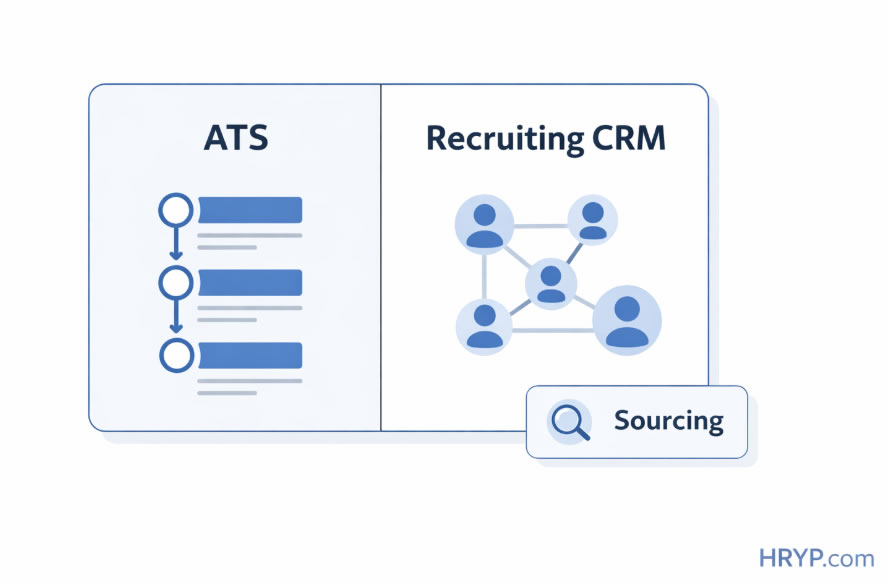
What an ATS is (in plain English)
An ATS is the system of record for candidates who apply to open roles. It’s where the hiring workflow lives: requisitions, applications, interviews, feedback, approvals, offers, and (often) reporting. Because it touches compliance and process, an ATS tends to be structured by design.
In other words, an ATS is built for active candidates and open roles. It’s what you need when your volume increases, your stakeholders multiply, or your hiring requires auditability.
ATS signals you’re solving
- “We need consistent pipeline stages across teams.”
- “Hiring managers keep losing feedback in Slack/email.”
- “We can’t reliably report source, time-to-fill, or stage conversion.”
- “We need permissions, approvals, and a clear hiring workflow.”
What a Recruiting CRM is (and what it isn’t)
A Recruiting CRM is designed for relationships and nurturing. It’s where you store and engage passive talent, build pools, run campaigns, track touchpoints, and keep warm pipelines over months (or years). Think “sales CRM,” but for talent.
Importantly, a Recruiting CRM is not meant to replace compliance-heavy hiring workflows. Instead, it’s meant to feed the ATS with better candidates—so you rely less on “post and pray.”
Recruiting CRM signals you’re solving
- “We’re always starting from zero for every role.”
- “Our recruiters need sequences, campaigns, and nurture.”
- “We want talent pools by skill, location, seniority, and interest.”
- “We do recurring hiring (sales, support, nurses, seasonal).”
Where sourcing tools fit
Sourcing tools help you find people and initiate outreach. They often include search, enrichment, and sometimes email automation. However, they usually don’t replace either an ATS or a Recruiting CRM for long-term process and data integrity.
A simple way to think about it:
- Sourcing tools = discover + initiate
- Recruiting CRM = nurture + manage relationships
- ATS = run structured hiring workflows for open roles
The 5-minute decision framework
Instead of comparing 80 features, answer these three questions. Then, pick the tool that matches your reality.
Question 1: Are you hiring for open roles right now—or building a pipeline for later?
- If your pain is moving applicants through stages, you need an ATS.
- If your pain is not having candidates to begin with, you likely need a Recruiting CRM (and/or better sourcing).
Question 2: Is compliance, auditability, or approvals a requirement?
- If yes, prioritize an ATS. Structure matters, and you’ll want consistent permissions, requisitions, and reporting.
- If no (early stage, low volume), you can sometimes start with a lighter ATS or an all-in-one tool—then upgrade when complexity increases.
Question 3: Do recruiters spend more time “managing process” or “creating pipeline”?
- If they’re buried in scheduling, feedback chasing, and stage management: ATS first.
- If they’re constantly prospecting and re-prospecting for similar roles: CRM (or CRM + ATS).
ATS vs Recruiting CRM vs Sourcing tools (comparison table)
| What you’re trying to do | ATS | Recruiting CRM | Sourcing tool |
|---|---|---|---|
| Manage applicants for open roles | Best fit | Limited | Not designed for this |
| Standardize stages, scorecards, approvals | Best fit | Usually secondary | Not designed for this |
| Build and nurture talent pools | Basic (varies) | Best fit | Helpful (top-of-funnel) |
| Run outreach sequences & campaigns | Sometimes (limited) | Best fit | Often included |
| Measure pipeline conversion + time-to-fill | Best fit | Good for engagement metrics | Partial |
| Keep clean candidate records over time | Good (active hiring) | Best fit (long-term relationships) | Varies |
| Support hiring manager collaboration | Best fit | Limited | No |
When you need both (the modern hiring stack)
In 2026, many teams end up with ATS + Recruiting CRM because the market demands both process and pipeline. Still, you don’t always need both on day one.
Common “ATS-first” scenario
If hiring is chaotic, start with the ATS. Then add CRM capability once the workflow is stable. Otherwise, you’ll nurture leads into a messy process—and lose them at the finish line.
Common “CRM-first” scenario
If you hire the same profiles repeatedly (or you’re in a niche market), start with CRM-like nurturing and sourcing. Then connect to an ATS once volume and stakeholder count grow.
Sourcing tool finds talent, CRM nurtures relationships, ATS converts candidates through a structured process.
“All-in-one” platforms: good or risky?
All-in-one platforms can work, especially for smaller teams. However, they often create trade-offs:
- Pros: fewer integrations, faster rollout, simpler vendor management.
- Cons: shallow CRM nurturing, limited reporting depth, or workflow rigidity.
Therefore, don’t ask “does it have CRM features?” Ask: does it help us maintain warm pipelines and measure engagement—without breaking the hiring workflow?
Common mistakes to avoid
Buying a Recruiting CRM to “fix” a broken hiring process
If your interview loop is disorganized, a CRM won’t solve it. It will simply deliver more candidates into the same bottleneck. Fix workflow first (ATS fundamentals), then scale pipeline.
Using an ATS as a long-term talent pool
ATS databases become messy when used as “the pool.” Contacts go cold, tagging is inconsistent, and engagement history gets lost. A CRM is built to keep relationships alive and searchable.
Measuring the wrong metrics
ATS success = time-to-fill, stage conversion, quality-of-hire proxies. CRM success = reply rates, reactivation, warm pool to hire conversion. If you mix these, you’ll “optimize” the wrong thing.
How to choose fast (without regret)
Once you know whether you’re ATS-first, CRM-first, or both, the next step is straightforward:
- List your top 3 workflows (e.g., hiring manager intake → interview loop → offer approvals).
- List your top 3 pipeline needs (e.g., seasonal pools, engineering niche skills, campus recruiting).
- Choose the tool that wins 80% of your reality today, then plan integrations for the next phase.
If you’re evaluating budget-friendly tools, you may also want: Best Free ATS & Recruiting Tools. If you’re building a broader stack, see: HR Tech Stack Trends (ATS, payroll, EOR and more).
FAQ
Is a Recruiting CRM the same as a sales CRM?
They’re conceptually similar (relationships, sequences, engagement history), but Recruiting CRMs are designed around talent pools, hiring workflows, and recruiting-specific data structures.
Can an ATS replace a Recruiting CRM?
Sometimes for small teams. However, ATS platforms typically struggle with long-term nurturing, campaign management, and talent pool reactivation at scale.
Do I need both an ATS and a Recruiting CRM?
If you have high hiring volume, recurring roles, or long lead times, you’ll often benefit from both. Start with the tool that solves your biggest bottleneck now, then add the other once you have a stable baseline.
What should I buy first as a startup?
Most startups do ATS-first when hiring becomes multi-stakeholder and repetitive. On the other hand, startups that rely heavily on outbound recruiting or niche talent may see faster results with CRM-style nurturing earlier.
How do I choose an ATS quickly?
Define your hiring workflow, required integrations, reporting needs, and stakeholder permissions. Then shortlist 3–5 tools and run a short pilot focused on your real workflow, not generic demos. You can start browsing options here: ATS vendors on HRYP.
Get Your HR Brand Featured on HRYP
Reach HR and business technology audiences with sponsored editorial coverage, vendor visibility and managed launch campaigns built for HR tech, SaaS and AI brands.
Sponsored editorial features from $170, with managed visibility and launch packages available.
:%20What%20Recruiting%20Teams%20Actually%20Need%20+%20A%20Simple%20Decision%20Framework)