


Introduction
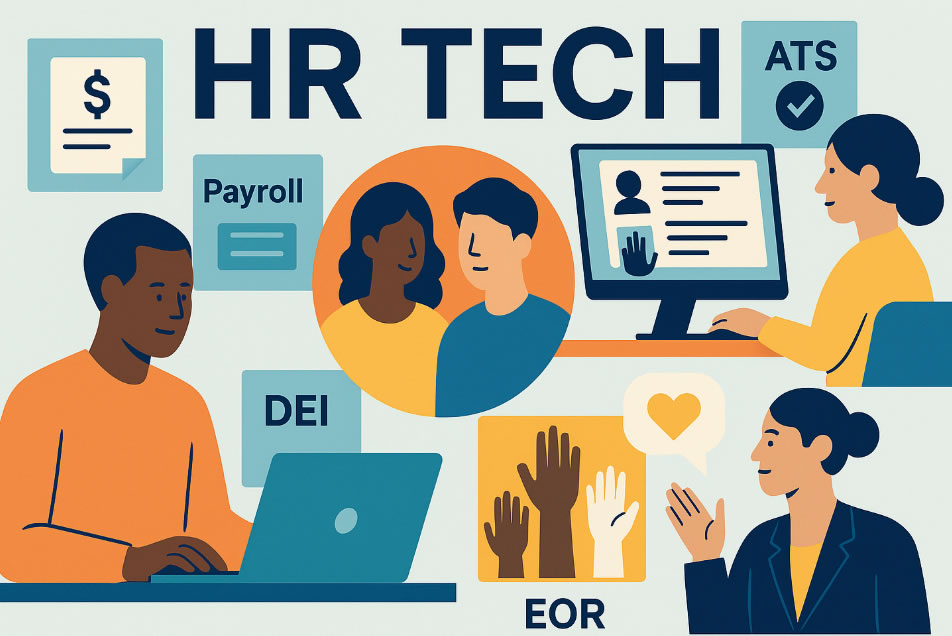
The HR landscape is evolving with unprecedented speed. Technologies that once felt optional are now essential. In 2025 and beyond, HR tech isn’t just about efficiency — it’s about creating an integrated ecosystem where payroll, EOR (Employer of Record), DEI (Diversity, Equity & Inclusion), ATS (Applicant Tracking Systems), and employee engagement work hand in hand to drive performance, culture, and retention.
In this article, you’ll get:
- Key trends and stats (2025)
- Strategic frameworks to tie together payroll, EOR, DEI, ATS, and engagement
- Examples of leading tools/platforms
- Best practices + pitfalls to avoid
- Internal & external links to deepen authority
- A call to action for HRYP’s audience
Macro Trends in HR Tech (2025): From Fragmentation to Intelligent Integration
The HR technology market in 2025 is experiencing one of its most transformative phases since the digitalization of HR began two decades ago. What was once a patchwork of disconnected tools—each solving a single HR pain point—is rapidly evolving into a unified, data-driven ecosystem.
According to Gartner, global HR tech spending is projected to surpass $400 billion by 2027, with double-digit annual growth driven by AI, automation, and the global expansion of hybrid workforces. Below are the key macro trends redefining the HR tech landscape this year.
The Rise of Unified HR Platforms
The biggest shift in 2025 is platform consolidation. Organizations are moving away from fragmented systems—separate tools for payroll, recruitment, learning, and performance management—toward integrated HR suites that centralize employee data.
This integration allows HR leaders to connect payroll accuracy with engagement metrics, or DEI analytics with hiring pipelines.
Key players such as Workday, SAP SuccessFactors, and Rippling have doubled down on modular, API-first architectures that let companies customize while maintaining a single source of truth.
Artificial Intelligence Moves from Hype to Utility
In 2025, AI in HR is no longer experimental—it’s operational. From AI-driven applicant screening and automated payroll validation to predictive attrition models, machine learning is embedded across HR functions.
According to Deloitte’s 2025 Human Capital Trends report, 72 % of CHROs plan to expand AI capabilities in talent acquisition and employee development within the next 12 months.
Concrete examples include:
- AI chatbots assisting with onboarding and HR inquiries.
- Predictive analytics identifying employees at risk of burnout or resignation.
- Generative AI crafting job descriptions, performance summaries, or DEI reports.
Yet, ethical oversight remains crucial. Without transparent data governance, AI can reinforce bias rather than eliminate it—especially in recruitment and compensation.
The Globalization of Work and the EOR Boom
The shift toward borderless hiring continues to accelerate. Remote work has matured from a pandemic necessity into a strategic advantage.
Companies are building distributed teams across continents, leading to explosive growth in Employer of Record (EOR) and global payroll platform such as Deel, Papaya Global, and Remote.
By outsourcing employment compliance, tax filing, and benefits administration, businesses can scale internationally without opening local entities.
However, the next frontier is EOR integration—embedding EOR data into HRIS, ATS, and finance systems to ensure consistent reporting and visibility across the workforce.
DEI + Analytics = Accountability
Diversity, Equity, and Inclusion (DEI) initiatives are no longer confined to HR presentations—they’re now measurable through technology.
Companies are using analytics dashboards to track representation, pay equity, promotion rates, and sentiment gaps across demographics.
Modern HR systems provide bias-aware hiring analytics, flagging patterns that may disadvantage certain groups. Tools like Textio and Pymetrics are leading this evolution.
Importantly, regulators and investors are paying attention: in the U.S., the SEC and Nasdaq are pushing for transparency in workforce diversity disclosures.
In Europe, new ESG reporting mandates make DEI a compliance requirement as well as a moral one.
Employee Experience Platforms (EXP) Take Center Stage
Engagement and retention have become the currency of modern HR. Traditional HRIS systems are being augmented—or replaced—by Employee Experience Platforms (EXP) that focus on personalized communication, recognition, and career growth.
According to Microsoft’s Work Trend Index, 48 % of employees globally say they would stay longer at their company if they felt more connected and recognized.
That’s why tools like Culture Amp, Lattice, and 15Five now integrate pulse surveys, feedback loops, and peer recognition directly into daily workflows.
This convergence of engagement and performance management turns HR software into a strategic enabler of culture rather than a back-office function.
Compliance, Security & Trust Become Differentiators
With the explosion of data across HR systems—ranging from payroll details to health and DEI analytics—data privacy and cybersecurity have become top priorities.
Vendors that demonstrate strong GDPR, SOC 2, and ISO 27001 compliance gain a competitive edge.
Beyond regulation, employee trust is a core pillar of HR tech adoption. Workers want assurance that their personal information, pay data, and performance metrics are stored and processed ethically.
The Shift Toward Analytics-Driven HR Strategy
Finally, the HR function itself is evolving. CHROs are no longer “people administrators”—they are data strategists.
Advanced analytics platforms now allow HR leaders to forecast turnover, correlate engagement with profitability, and measure ROI on learning and development programs.
As HR tech becomes predictive, data literacy within HR teams is emerging as a core skill.
Organizations that can translate HR data into strategic action are outperforming competitors on both talent retention and operational efficiency.
Payroll & Its Evolution in HR Tech
Payroll is the backbone. If payroll is wrong, everything else crumbles.
Why payroll matters in modern HR tech
- It’s a trust point: employees expect accurate, timely pay.
- It’s legally complex: tax rules, social contributions, compliance.
- It integrates with compensation, benefits, performance, and finance systems.
Trends & innovations
- Automation & real-time processing: Traditional biweekly/monthly cycles are giving way to more frequent or on-demand pay.
- Embedded tax & compliance engines: Payroll systems now auto-update for jurisdictional changes.
- Global payroll + EOR bundling: Many payroll techs partner with or include EOR modules to manage cross-border pay.
- APIs & microservices: Payroll engines become plug-and-play parts of the HR stack.
Pitfalls to avoid
- Legacy systems that can’t scale or integrate
- Lack of audit trails or transparency
- Poor localization in multi-country setups
- Inflexible pay cycles or compensation models
EOR: The Bridge for Global & Remote HR
Employer of Record (EOR) is a growing tool to manage hiring, compliance, and payroll in regions where the company lacks a legal entity.
Why use EOR?
- Speed & flexibility: Onboard talent in new markets within weeks
- Compliance & risk reduction: The EOR handles local labor laws, taxes, benefits
- Focus on core HR: Allows your internal team to avoid the legal/administrative burden
Challenges & best practices
- Choose an EOR with strong local presence and legal expertise
- Ensure transparency in cost structure (markup, benefits, payroll)
- Integrate the EOR’s systems with your core HRIS or platform (so data flows)
- Monitor employee experience carefully: employees might feel “outsourced” if handled poorly
Research insight
A study on employee-organization relationships (EOR data science) highlights that perception, satisfaction, and environment scrutiny are critical in EOR setups.
DEI Embedded in HR Tech
DEI is no longer a nice-to-have; it’s strategically vital — and HR tech is a powerful lever.
DEI can be enforced through tech via
- Bias mitigation in hiring (blind screening, audit logs)
- Demographic dashboards & analytics
- Pay equity tools (comparing compensation across gender, race, roles)
- Inclusive feedback & sentiment analysis
- Training modules and micro-learning for inclusive behaviors
Risks & ethical guardrails
- AI bias: if the training data is skewed, automation can reinforce discrimination
- Transparency & trust: employees must understand how data is used
- Privacy & anonymization: demographic data must be handled with care
A recent study on AI and employee well-being warns that improperly implemented AI can erode trust, cause fairness concerns, or impact mental health.
ATS & Talent Acquisition — The Funnel Reimagined
The ATS is at the front end of your HR stack. It captures the candidate journey.
Modern ATS capabilities
- AI screening & matching
- Job distribution across channels
- Interview scheduling & automation
- Candidate experience tracking
- Diversity-aware screening
- Integration with HRIS, onboarding, assessments
Emerging trends
- Skills-based hiring: shifting focus from degrees to competencies. –> arXiv
- Predictive hiring: using analytics to forecast quality of hire, turnover risk
- Conversational AI for candidate engagement
Metrics to monitor
- Time to hire
- Offer acceptance rate
- Source-of-hire ROI
- Candidate drop-off rates by stage (and by demographic subgroup)
- Hiring diversity ratios
Employee Engagement — The Human Core
All the tech is worthless if your people are disengaged.
What “engagement” means today
- Psychological safety: employees feel they can voice ideas
- Meaning & alignment: people understand how their work matters
- Real-time feedback, recognition & growth pathways
- Work/life flexibility & wellness support
How HR tech supports engagement
- Pulse surveys / sentiment analysis: spot issues early
- Recognition engines: micro-rewards, peer-to-peer shoutouts
- Learning & development integration: continuous upskilling
- Career pathing & transparency
- Wellness tools & digital benefits
Key challenges
- Survey fatigue — too many questionnaires
- Data overload without action
- Lack of manager buy-in
Tying It All Together: Building Your HR Tech Stack Strategy
Here’s how to orchestrate the above components into one cohesive stack.
| Component | Role in Stack | Integration Points | Success Metric |
|---|---|---|---|
| Payroll | Core finance/HR engine | Compensation, benefits, reporting, EOR | Payroll accuracy, cost per pay run |
| EOR | Cross-border legal & compliance | Payroll, HRIS, contractor management | Time to onboard, compliance incidents |
| ATS | Talent funnel | Onboarding, assessments, HRIS | Time-to-hire, candidate satisfaction |
| DEI | Guardrails & analytics | All HR modules, reporting | Diversity metrics, equity gaps |
| Engagement | Experience layer | Performance, feedback, L&D | eNPS, retention, sentiment scores |
Framework for rollout
- Audit your current stack: find gaps & overlaps
- Prioritize integration-first tools
- Start small (pilot) — ideally with one business unit
- Invest in manager training & change management
- Close the loop: measure, iterate, refine
Recommended Tools & Platforms
Workday, SAP SuccessFactors, Oracle HCM Cloud — enterprise HR suites
Rippling, Gusto, ADP — payroll + HR integrations
Papaya Global, Deel, Remote — global payroll + EOR
Greenhouse, Lever, SmartRecruiters — modern ATS
Culture Amp, 15Five, Lattice — engagement & performance
Pymetrics, FairHiring, Textio — DEI / bias assistive tools
FAQ – HR Tech, Payroll, EOR, DEI, ATS & Employee Engagement (2025)
1. What Is HR Tech and Why Is It So Important in 2025?
Answer:
HR Tech refers to the software, tools, and platforms used to manage workforce operations—from payroll and recruitment to engagement and analytics.
In 2025, HR Tech is essential because it unifies data across all HR functions, enabling smarter decisions, improved compliance, and stronger employee experiences.
2. How Does HR Tech Improve Payroll and Compliance?
Answer:
Modern HR Tech automates payroll calculations, tax updates, and compliance reporting. It eliminates manual errors and ensures that employees are paid correctly and on time, even across multiple countries.
Integrated payroll software—like Deel, Gusto, or Papaya Global—also syncs with HRIS and finance systems for seamless compliance management.
3. What Is an Employer of Record (EOR) and How Does It Fit Into HR Tech?
Answer:
An Employer of Record (EOR) is a service provider that legally employs workers on behalf of another company in foreign markets.
Within the HR Tech ecosystem, EOR platforms integrate payroll, benefits, and compliance data to help companies hire globally without setting up local entities—reducing risk and speeding up expansion.
4. How Does HR Tech Support DEI (Diversity, Equity & Inclusion) Goals?
Answer:
HR Tech enables measurable DEI impact through analytics dashboards, bias detection tools, and pay equity reporting.
AI-driven solutions like Textio and Pymetrics help ensure inclusive job descriptions, equitable candidate assessments, and ongoing visibility into representation across departments.
5. How Are ATS Platforms Evolving in the HR Tech Landscape?
Answer:
Applicant Tracking Systems (ATS) are now AI-enhanced, automating job posting, screening, and scheduling while improving candidate experience.
Modern ATS tools integrate DEI analytics, predictive hiring, and seamless onboarding—turning recruitment into a strategic, data-driven function.
6. How Does HR Tech Increase Employee Engagement and Retention?
Answer:
HR Tech boosts engagement through continuous feedback, recognition programs, and wellness integrations.
Platforms like Culture Amp or 15Five deliver real-time insights into sentiment and performance, enabling leaders to act before disengagement turns into turnover.
7. What Are the Biggest HR Tech Trends to Watch Beyond 2025?
Answer:
Expect deeper integration of AI, predictive analytics, and employee experience platforms (EXP).
Data privacy, ethical AI, and skills-based hiring will dominate the next wave of innovation, making HR Tech the backbone of every modern organization.
