


Introduction: Why HR Systems Fragmentation Hurts Businesses
HR teams today are expected to move fast — managing payroll, compliance, benefits, and employee engagement while supporting business growth. Yet too often, these functions are handled through a patchwork of disconnected systems. One platform for payroll, another for benefits, spreadsheets for time tracking, and a separate tool for performance reviews.
At first, this setup may seem manageable. But as a company grows, the cracks start to show. Data becomes inconsistent, reporting takes longer, compliance risks increase, and employees grow frustrated with multiple logins and processes that don’t connect.
This fragmentation of HR systems comes with hidden costs that drain productivity and create risk. The alternative is clear: moving to an all-in-one HR & payroll platform that unifies essential functions under one roof, saving time and enabling HR teams to focus on strategy rather than admin.
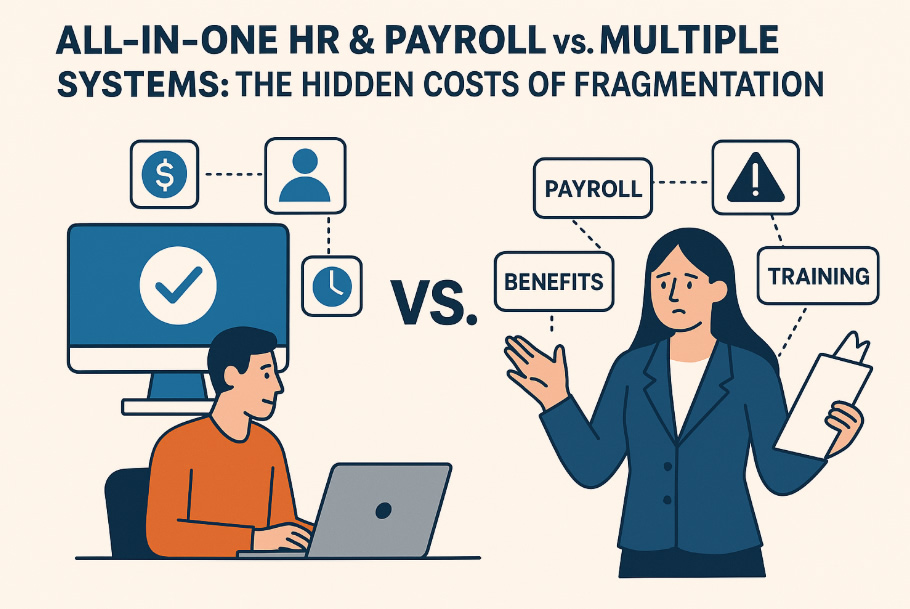
The Rise of All-in-One HR Platforms
The HR tech landscape has evolved dramatically. A decade ago, companies often purchased specialized tools for each HR function — payroll, benefits, time tracking, learning management, and recruitment. While this modular approach offered flexibility, it also created a spider web of disconnected systems.
Today, forward-thinking companies are moving toward unified Human Capital Management (HCM) platforms. These all-in-one solutions integrate payroll, HR, benefits, compliance, and engagement tools into a single system of record.
Why the shift? Because the modern workforce demands efficiency and seamless experiences — not just for HR teams, but for employees who expect mobile access, self-service, and real-time data.
Hidden Costs of Multiple HR Systems
At first glance, using several specialized tools may seem manageable. But beneath the surface, hidden costs accumulate. Let’s break them down.
Time & Productivity Loss
- HR teams spend hours reconciling data across platforms.
- Duplicate data entry (e.g., adding a new hire into payroll, then again into benefits, then again into performance tracking).
- Manual reporting slows decision-making.
Compliance Risks
- Fragmented systems make it harder to keep up with changing labor laws.
- Missed tax updates or misaligned timekeeping can lead to fines.
- Audit trails are incomplete when data is scattered.
Data Inconsistency
- Employee information differs across systems (name changes, benefits elections, job titles).
- Managers struggle to get a single source of truth.
- Errors cascade when multiple systems don’t sync in real time.
Higher Total Cost of Ownership
- Licenses for separate tools add up quickly.
- IT costs rise due to integrations and maintenance.
- Training employees on multiple platforms wastes time and money.
🚀 Ready to streamline HR & Payroll?
Discover Paylocity’s all-in-one HR platform and eliminate the hidden costs of fragmented systems.
Try Paylocity TodayBenefits of an All-in-One HR & Payroll Solution
By contrast, an integrated HR & payroll platform eliminates silos and creates a streamlined hub for all employee data and processes.
Centralized Data Hub
All employee records — from onboarding to payroll to performance — live in one place, reducing errors and providing real-time visibility.
Streamlined Compliance & Reporting
With built-in compliance updates and consolidated reporting, HR teams can minimize risk while saving time.
Improved Employee Experience
Mobile apps and self-service features empower employees to access pay stubs, request time off, and update personal info without HR intervention.
Scalability for Growing Teams
Whether you have 50 employees or 5,000, a unified system grows with you — no need to constantly add (and integrate) new tools.
Comparison: Fragmented Systems vs. All-in-One HR Platform
| Feature | Multiple Systems | All-in-One HR Platform |
|---|---|---|
| Data Management | Scattered across tools, prone to errors | Single source of truth, centralized updates |
| Compliance | Harder to track, higher risk of fines | Automatic updates, consolidated reporting |
| Employee Experience | Multiple logins, inconsistent UX | Seamless self-service & mobile access |
| Costs | Licenses + integrations + IT overhead | One subscription, predictable pricing |
| Scalability | Breaks down as company grows | Grows with your business needs |
Real-World Example: From Fragmentation to Integration
Consider a mid-sized manufacturing company with 300 employees. Initially, they managed payroll with one provider, tracked time in spreadsheets, used a separate tool for performance reviews, and outsourced benefits administration.
The result? HR staff spent 15+ hours a week reconciling data across systems. Employees complained about multiple logins and slow responses. During an audit, compliance gaps emerged — costing the company fines.
After switching to an all-in-one HR platform, they:
- Reduced administrative hours by 40%.
- Cut IT integration costs by $20K annually.
- Increased employee self-service adoption to 85%.
The ROI was clear within the first year.
👉 Cut errors, save time, and scale faster with Paylocity’s all-in-one HR platform .
How to Decide If It’s Time to Consolidate
Here are key signals that indicate your business may be ready to shift from multiple systems to one integrated HRIS:
- You’re duplicating employee data across 3+ platforms.
- Compliance reporting takes days, not hours.
- Employees struggle with multiple logins and inconsistent access.
- IT is constantly patching integrations between vendors.
- HR teams spend more time on admin than strategy.
If these sound familiar, your company may be paying the hidden costs of fragmentation — and it’s time to consider a unified solution.
Conclusion: The Future of HR is Unified
Fragmented HR systems may get the job done in the short term, but over time they create silos, errors, and unnecessary costs. When payroll, compliance, benefits, and employee data are scattered across multiple tools, HR teams spend more energy fixing problems than driving strategy.
An all-in-one HR & payroll platform changes that equation. By consolidating processes into a single hub, companies gain real-time visibility, stronger compliance, and a smoother experience for employees and managers alike. The result is not just efficiency — it’s the ability to scale with confidence.
Forward-looking organizations are already making this shift. If your team is still juggling separate systems, now is the time to ask: what is fragmentation costing us — and how much more could we achieve with a unified HR platform?
Discover how Paylocity can help you streamline payroll, benefits, compliance, and employee engagement in one seamless platform. With Paylocity, HR teams save time, reduce risk, and deliver a better employee experience — all while building a scalable foundation for growth.

All-in-One HR Platform FAQs
What are the disadvantages of using multiple HR systems?
They create data silos, increase compliance risks, require duplicate data entry, and raise costs due to multiple licenses and integrations.
Why choose an all-in-one HR and payroll solution?
It centralizes employee data, improves compliance, enhances employee experience, and reduces overall costs.
How can an integrated HRIS reduce compliance risks?
By automating tax updates, providing consolidated reporting, and ensuring consistent data across functions.
Is an all-in-one HR platform more cost-effective?
Yes — while upfront costs may be higher, savings in time, IT, compliance, and employee satisfaction deliver greater long-term ROI.
