

US Pay Transparency Laws by State (2026)
Pay transparency is no longer a “nice-to-have” in U.S. hiring. In 2026, more states require employers to disclose pay ranges (and often benefits/other compensation) in job postings, promotions, and internal transfers. If you recruit across states—or hire remotely—your job ads can trigger multiple rules at once.
This guide gives you a practical, HR-friendly checklist to stay compliant, reduce risk, and build a repeatable workflow that your recruiters and hiring managers will actually follow.
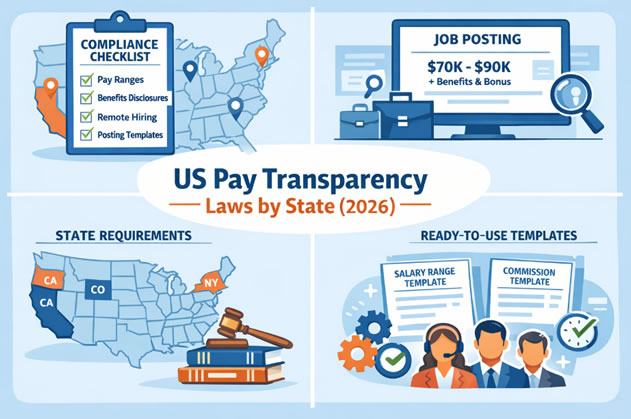
What “pay transparency” usually means in practice
- Pay range in job postings (min–max salary or hourly wage), often required on internal and external postings.
- Benefits + other compensation (e.g., bonus, commissions, equity, retirement, healthcare) in some states.
- Promotion/transfer transparency (posting or notification rules, and ranges for internal moves).
- Anti-retaliation protections for employees/applicants who request pay information.
- Recordkeeping obligations (varies by state) to prove your postings were compliant.
Remote hiring: the #1 way teams accidentally violate these laws
Many pay transparency rules apply when a role is performed “at least in part” in the state, or when a role reports to a supervisor/office located in the state. That means a “remote” posting can still be covered even if your HQ is elsewhere.
Operational takeaway: treat pay transparency like multi-state payroll—design for cross-state coverage by default, then tailor for edge cases.
2026 compliance in one page
Step 1: Define your “good-faith” range rules
- Range logic: decide how you set min/mid/max (market data + internal leveling + budget).
- Eligibility: define whether remote/hybrid roles have one national range or geo-differentials.
- Guardrails: require comp approval if an offer is outside the posted range.
Step 2: Standardize job posting content
- Always include minimum and maximum pay (avoid open-ended ranges).
- Add a short “what’s included” line for bonus/commission/equity and major benefits.
- For commission-based roles, clearly state commission-based where required.
Step 3: Build an approval workflow in ATS + HRIS
- Create a single source of truth: job level → pay band → posting template.
- Lock the range fields in your ATS so recruiters can’t “free-type” a different range.
- Keep a copy of the posting and range used at the time of posting (for audit/defense).
Step 4: Train recruiters and hiring managers
- How to answer “Can I negotiate above max?” (use a scripted policy answer).
- What to do when a candidate is in a different state than expected.
- How to explain ranges without creating pay compression internally.
Step 5: Audit monthly
- Spot-check live postings (company site + job boards + agency postings).
- Verify benefits/other comp language where required.
- Confirm promotions/transfers follow the same rules.
State snapshot: common pay transparency requirements (2026)
The table below is a practical snapshot of widely referenced state requirements. Always confirm edge cases (role location, reporting line, remote work definitions, and local city ordinances) with official guidance or counsel.
| State | Typical employer threshold | What must be disclosed | When it applies | Practical notes |
|---|---|---|---|---|
| California | 15+ employees (posting pay scale) | Pay scale in job postings; pay scale on request (applicants/employees) | Job postings; employee/applicant requests | Use a documented “good-faith” range; keep posting records and titles consistent across systems. |
| Colorado | Covered employers posting/notice rules | Compensation range + (commonly) benefits/other comp; promotion opportunities | Internal/external postings; promotion announcements | Be careful with remote roles and third-party postings—Colorado is enforcement-active. |
| Washington | 15+ employees | Wage scale/salary range + general benefits + other compensation | Job postings for covered Washington roles | Include bonus/equity language and a benefits summary line to reduce risk. |
| New York (State) | 4+ employees | Compensation range (min–max) and note if commission-based | Advertised opportunities, promotions, and transfers | Also check city rules (e.g., NYC) if the job is performed there. |
| Illinois | 15+ employees (if you post) | Pay scale/compensation + benefits in internal/external postings | Postings for work performed (at least partly) in Illinois or reporting into Illinois | Add a standard benefits line to every IL-covered posting; notify employees of public opportunities. |
| Massachusetts | 25+ employees | Wage range in postings; ranges to applicants/employees in certain contexts | Job postings, promotions/transfers, and requests (per MA guidance) | Set internal controls so recruiters don’t publish “placeholder” ranges. |
| New Jersey | 10+ employees | Pay + benefits + other compensation programs; promotion notifications | New jobs and transfer opportunities; reasonable efforts to notify promotions | Make promo notices part of your internal mobility workflow, not a one-off email. |
| Maryland | Applies broadly to covered postings | Pay range (min–max) + benefits + other compensation | All internal/external solicitations for roles performed at least partly in Maryland | If you repost or amend a posting after the effective date, the rules can apply. |
| Minnesota | 30+ employees | Starting salary range (or fixed rate) + benefits + other compensation | Job postings for each job opening | Avoid open-ended ranges; document the “budgeted” range used for postings. |
| Connecticut | All employers | Wage range upon request or before offer; notices at hire/role changes | Applicant request / before offer; employees at hire or first request | Even if CT doesn’t require posting ranges in every ad, you still need a ready-to-share range. |
| Vermont | Varies (state guidance) | Pay range requirements for covered postings; wage discussion protections | Covered job postings and hiring processes | Treat Vermont as “posting-range-ready” if you recruit there, especially for remote roles. |
Copy-paste posting templates (safe default for multi-state hiring)
Use these templates as a starting point. They’re designed to be compatible with the stricter “posting disclosure” states (range + benefits + other compensation). You should still tailor to your role and confirm state-specific requirements.
Template A: Salary/Hourly + benefits + other compensation
Compensation: The pay range for this role is $[MIN] – $[MAX] per [hour/year]. Actual pay depends on skills, experience, and location.
Benefits: This role includes [medical/dental/vision], [401(k)/retirement], paid time off, and other benefits in line with company policy.
Other compensation: This role may be eligible for [annual bonus], [commission], and/or [equity] depending on performance and plan terms.
Location: [On-site/Hybrid/Remote]. If remote, the role is open to candidates in: [LIST STATES] (or “remote within the U.S.” if you publish national ranges).
Template B: Commission-based roles
Compensation: This is a commission-based role. The pay range for expected total compensation is $[MIN] – $[MAX] per year, including base + commission (where applicable).
Base pay (if applicable): $[BASE_MIN] – $[BASE_MAX] per year.
Benefits + other compensation: Eligible for [benefits], and may include [bonus/equity] based on plan terms.
Common mistakes that create avoidable risk
- Open-ended ranges (“$70k+” or “up to $120k”) that don’t show a clear min–max.
- Placeholder ranges that are clearly not “good-faith” (too wide or unrealistic).
- Different ranges across job boards (company site says $90–110k, LinkedIn says $80–140k).
- No benefits language in states that explicitly require it (or where your policy is to standardize for all).
- Recruiter workarounds (editing the range field after approvals because “the market changed”).
- Not treating internal mobility (promotions/transfers) with the same discipline as external hiring.
How HR tech helps you scale compliance without slowing hiring
The fastest way to “stay compliant” is to reduce manual work. Mature teams centralize pay bands, tie them to job levels, and publish approved ranges directly through ATS templates—so every posting stays consistent.
- Compensation management to define job architecture and bands (and keep audit trails).
- Pay equity analytics to detect compression and unexplained gaps as transparency increases.
- ATS controls to prevent range edits and ensure board postings match the approved language.
- Multi-state payroll + HR compliance to align job offers, onboarding, and location-based rules.
Authoritative resources
- New York State DOL – Pay Transparency
- Colorado CDLE – Equal Pay for Equal Work Act
- Washington RCW 49.58.110 – Job posting wage/salary range disclosure
- Illinois DOL – Salary transparency guidance
- Maryland DOL – Wage Range Transparency FAQ
- Massachusetts – Pay transparency overview
- New Jersey DOL – Pay & benefits transparency
FAQ
Do we need to post pay ranges for remote roles?
Often, yes. Several state rules focus on where the work is performed (even partly) or where the role reports. If you recruit nationally, it’s safest to build pay ranges and templates as if remote roles can be covered.
How wide can a pay range be without raising red flags?
There’s no universal “perfect width,” but extremely wide ranges can look non-credible. Use a documented range methodology (leveling + market + budget) and publish a range that reflects what you realistically expect to pay.
Do we have to include benefits and other compensation?
In some states, yes. Even where it’s not mandatory, including a short benefits/other compensation line is a smart standardization move that reduces compliance complexity across states.
What about promotions and transfers?
Some states require ranges on promotion/transfer opportunities and/or reasonable efforts to notify employees about promotional opportunities. Treat internal mobility like external recruiting—same templates, same approvals, same audit trail.
If we use third-party recruiters or job boards, are we still responsible?
Usually yes. Many rules apply whether the employer posts directly or through a third party. Provide approved posting language to agencies and periodically audit live postings on external boards.
What’s the simplest way to stay compliant without slowing hiring?
Centralize pay bands, lock pay range fields in the ATS, and use pre-approved posting templates. Then run a monthly audit of postings across your site and major job boards.
Get Your HR Brand Featured on HRYP
Reach HR and business technology audiences with sponsored editorial coverage, vendor visibility and managed launch campaigns built for HR tech, SaaS and AI brands.
Sponsored editorial features from $170, with managed visibility and launch packages available.
:%20HR%20Compliance%20Checklist%20+%20Posting%20Templates)