

Quick Summary
HR Tech Stack Audit Checklist
An HR tech stack audit is a structured review of all HR software, vendors, integrations, and manual workflows used across recruiting, payroll, onboarding, compliance, DEI, analytics, employee management, and candidate evaluation.
- Main goal: identify gaps, reduce duplicate tools, improve data flow, and make better HR vendor decisions.
- Key areas to review: payroll, HRIS, ATS, candidate screening, DEI tools, onboarding, compliance, analytics, and vendor support.
- Warning signs: manual reports, disconnected systems, unused licenses, overlapping features, payroll errors, and poor recruiter adoption.
- Best timing: run an audit before a major vendor renewal, after fast hiring growth, during global expansion, or when HR costs rise without clear value.
- Final outcome: keep the tools that create measurable value, replace weak vendors, consolidate overlap, and build a cleaner HR technology stack.
A growing HR team rarely starts with a perfectly designed technology stack. It usually starts with one payroll tool, one recruiting tool, a spreadsheet, a few manual workflows, and several point solutions added whenever a new problem appears.That is normal. But over time, this patchwork can become expensive, difficult to manage, and risky. Payroll data may not connect cleanly with HR records. Recruiters may use one platform for applicant tracking and another for candidate relationship management. Compliance documentation may sit in shared folders. Hiring teams may rely on manual CV checks even when candidate quality is becoming harder to verify.
An HR tech stack audit helps companies step back and answer a practical question: are our HR tools still supporting the business, or are they creating friction?
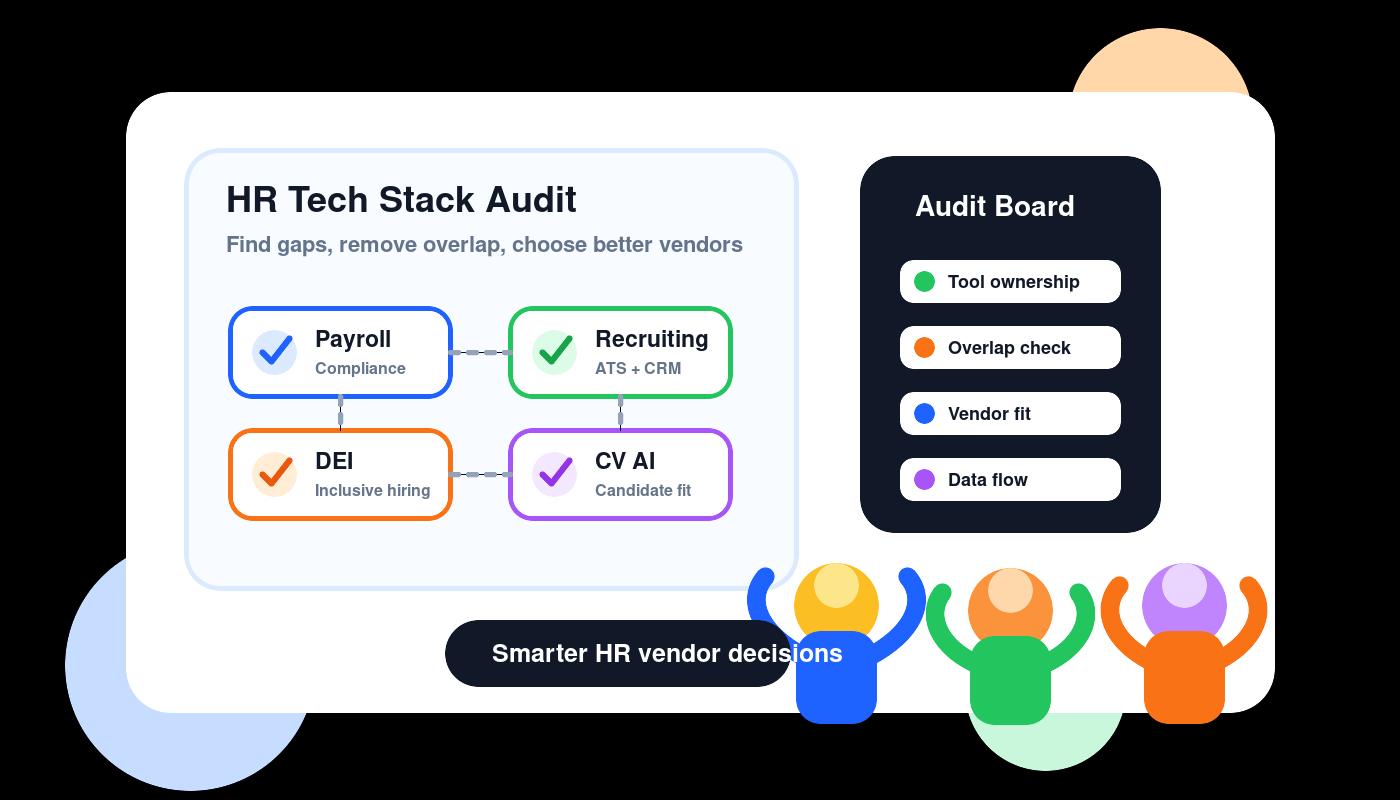
This guide gives HR leaders, founders, people operations teams, and growing companies a clear checklist for reviewing their HR technology stack, finding gaps, reducing tool overlap, and choosing better vendors.
What Is an HR Tech Stack Audit?
An HR tech stack audit is a structured review of all the software, platforms, vendors, and manual workflows used across the employee lifecycle. It looks at tools for payroll, recruiting, onboarding, compliance, benefits, employee engagement, performance, document management, analytics, and candidate evaluation.
The goal is not simply to cut tools. The real goal is to understand whether each tool still has a clear job, whether teams actually use it, whether data flows correctly, and whether the company is paying for overlapping features.
A good audit answers questions such as:
- Which HR processes are still too manual?
- Which tools are underused or duplicated?
- Where do data errors or compliance risks appear?
- Which tools are helping HR move faster?
- Which vendors should be replaced, consolidated, or upgraded?
If your company is already comparing new platforms, start with the HR Software Evaluation Checklist. That article gives a detailed framework for shortlisting vendors and avoiding common HR tech buying mistakes.
Why HR Tech Stacks Become Messy
HR software decisions are often made under pressure. A company needs payroll quickly. Then it needs an ATS. Then it needs contractor onboarding, compliance support, employee surveys, document generation, or DEI reporting. Each tool solves a real problem at the time, but nobody always checks how the new tool fits into the whole system.
Common causes of HR stack complexity include:
- Fast hiring growth: recruiting needs increase before workflows are mature.
- Multi-state or global expansion: payroll and compliance become more complex.
- Department-level purchases: teams buy tools without central coordination.
- Manual workarounds: spreadsheets remain in use even after software is adopted.
- Vendor overlap: multiple platforms offer similar features, but none are fully used.
This is why an audit should not be seen as an IT exercise only. It is a business exercise. HR technology affects hiring speed, payroll accuracy, compliance exposure, employee experience, and leadership reporting.
The HR Tech Stack Audit Checklist
Use the checklist below to review your current tools and decide what to keep, replace, consolidate, or improve.
1. Map Every HR Tool Currently in Use
Start with a complete inventory. Do not limit the audit to official HR platforms. Include spreadsheets, shared drives, internal forms, templates, email-based approvals, payroll portals, contractor management systems, background check tools, CV screening tools, performance tools, and employee communication platforms.
For each tool, document:
- Tool name and vendor
- Main owner inside the company
- Primary use case
- Monthly or annual cost
- Number of active users
- Renewal date
- Critical integrations
- Known problems or limitations
This first step often reveals tools that nobody owns, licenses that are still being paid for, and workflows that are more manual than leadership realizes.
2. Separate Core Systems From Point Solutions
Not every HR tool has the same weight. Some systems are core infrastructure. Others are specialized tools that solve one specific problem.
Core systems usually include payroll, HRIS, ATS, benefits administration, time tracking, and compliance tools. Point solutions may include employee recognition, survey tools, candidate testing, AI document generators, DEI sourcing tools, or CV analysis tools.
The audit should clarify which platforms are central to your HR operations and which tools support specific moments in the employee lifecycle.
3. Review Payroll and Compliance First
Payroll should be one of the first areas reviewed because errors can create employee trust issues, tax problems, and compliance exposure. A payroll platform that worked for a small team may not be enough once the company hires across multiple states, uses contractors, adds benefits, or expands internationally.
Look at accuracy, tax handling, reporting, integrations, employee self-service, support quality, and compliance coverage. If the company is operating in the United States, the guide on how to choose the right payroll company in the USA is a useful companion resource.
For companies already dealing with multi-state hiring, payroll should also be reviewed against state registrations, withholding rules, reciprocity agreements, remote employee policies, and year-end reporting obligations.
4. Check Whether Your ATS Still Matches Your Recruiting Process
Many companies outgrow their first recruiting system. The ATS may be too basic, too complicated, poorly adopted by hiring managers, or disconnected from sourcing and candidate relationship management.
An ATS audit should review:
- Candidate pipeline visibility
- Hiring manager collaboration
- Interview feedback workflows
- Automation quality
- Integration with job boards and career pages
- Reporting on time-to-fill and source quality
- Candidate experience
If your team is debating whether it needs an ATS, a recruiting CRM, or both, read ATS vs Recruiting CRM. That distinction matters because the wrong choice can create confusion in the hiring process.
5. Evaluate Candidate Screening and CV Review Workflows
Recruiters are under pressure to move quickly, but speed should not come at the cost of candidate quality. A modern HR stack should help teams review resumes consistently, compare CVs to job descriptions, identify relevant experience, and spot potential red flags.
This does not mean replacing recruiter judgment. It means giving recruiters better support. For a practical view of this balance, see how recruiters can use AI for CV screening without losing human judgment.
HRYP also offers the CV Insights Tool, built to help recruiters analyze CVs, compare candidate fit, and screen faster with more confidence.
6. Audit DEI and Inclusive Hiring Tools
DEI tools should not be treated as decorative add-ons. If a company is serious about inclusive hiring, the HR stack should help improve sourcing, reduce bias in workflows, measure pipeline diversity, and support better decision-making.
During the audit, check whether your tools help with:
- Inclusive job descriptions
- Diverse candidate sourcing
- Structured interview processes
- Pipeline analytics
- Bias reduction in screening and evaluation
The Diversity Recruiting Tools Buyer Guide gives a more detailed framework for teams evaluating inclusive hiring technology.
7. Identify Duplicate Features and Tool Overlap
One of the fastest ways to reduce HR technology waste is to find overlapping features. For example, your HRIS may already include onboarding workflows, document storage, surveys, or performance review features. Your payroll provider may include HR support, compliance alerts, time tracking, and benefits administration. Your ATS may include candidate communication automation that another tool also provides.
The question is not only whether features exist. The better question is whether the team actually uses them well.
For each overlap, decide whether to:
- Keep both tools because they solve different needs
- Consolidate into one platform
- Replace both with a stronger vendor
- Remove the unused tool entirely
This is where cost discipline matters. Paying more for one well-integrated platform can sometimes be cheaper than managing five disconnected tools that create manual work.
8. Review Integrations and Data Flow
Disconnected HR systems create hidden costs. A payroll error may start with a bad HRIS sync. A recruiting report may be unreliable because candidate source data is not captured correctly. A compliance process may fail because employee records are stored in different places.
Review how data moves between systems. Pay special attention to employee records, compensation data, job changes, hiring status, onboarding documents, time tracking, benefits, and termination workflows.
Ask each vendor what integrations are native, what requires API work, and what still depends on manual export/import. Manual data transfer is often a sign that the stack is no longer mature enough for the company.
9. Compare Vendor Support, Pricing, and Contract Flexibility
A tool can look strong in a demo and still disappoint after implementation. Support quality, onboarding guidance, documentation, billing flexibility, contract terms, and renewal behavior all matter.
During the audit, review:
- Support response times
- Implementation experience
- Training resources
- Pricing transparency
- Renewal terms
- Scalability as headcount grows
- Customer reviews and case studies
If you are actively researching HR vendors, the Human Resources Directory Guide explains how to use HR directories to find vendors by category, use case, and location.
When Should a Company Run an HR Tech Stack Audit?
Companies should not wait until the HR stack is completely broken. A structured review is useful whenever the business changes in a meaningful way.
Run an HR tech stack audit when:
- The company is hiring faster than before
- HR costs are rising without clear value
- Payroll or compliance complexity increases
- Recruiting workflows feel slow or inconsistent
- Managers complain about too many systems
- Reports are built manually every month
- Employee data is duplicated across platforms
- A major vendor contract is about to renew
A yearly audit is healthy for most growing companies. A faster-growing company may need a lighter review every six months.
How to Score Each HR Tool
To make the audit practical, score each tool from 1 to 5 across five categories:
- Business value: does it solve an important problem?
- Adoption: do people actually use it?
- Integration: does it connect well with the rest of the stack?
- Cost efficiency: is the price justified by usage and outcomes?
- Scalability: can it support the next stage of growth?
Tools with low scores across multiple categories should be reviewed immediately. Tools with high value but poor adoption may need better training, workflow redesign, or clearer ownership. Tools with high cost and low usage are candidates for cancellation or replacement.
How HR Vendors Can Stand Out During the Buying Process
This audit process is also useful for HR vendors. Buyers are becoming more selective. They want clear positioning, proof of value, transparent pricing, and practical use cases.
If you sell HR software, payroll services, recruiting technology, DEI tools, consulting, or candidate evaluation solutions, your visibility matters. Being present in the right HR directories and educational content can help buyers discover your company when they are actively comparing options.
That is one reason many HR companies choose to join HRYP through directory listings and separate editorial visibility services.
Want HR Buyers to Discover Your Company?
If your company provides HR software, payroll services, recruiting solutions, DEI technology, consulting, or employee management tools, HRYP can help you increase visibility through a dedicated listing, editorial content, and internal placement across relevant HR buyer guides.
Final Thoughts
An HR tech stack audit is not about using fewer tools for the sake of simplicity. It is about building a cleaner, more effective system that supports hiring, payroll, compliance, employee experience, and leadership decision-making.
The best HR stacks are not necessarily the biggest. They are the ones where every tool has a clear purpose, data flows correctly, teams know what to use, and vendors are selected based on real business needs.
For growing companies, the smartest move is to audit before the stack becomes painful. For HR vendors, the opportunity is to show up clearly when buyers are already searching for better solutions.
Get Your HR Brand Featured on HRYP
Reach HR and business technology audiences with sponsored editorial coverage, vendor visibility and managed launch campaigns built for HR tech, SaaS and AI brands.
Sponsored editorial features from $170, with managed visibility and launch packages available.
